
Mulberry Silk Grades vs Momme Weight: How To Specify Fabric For Private Label Orders
You want premium silk products that feel luxurious, perform well, and protect your brand margin. But suppliers speak in two languages—“grades” and “momme”—that often get mixed up. In this guide, YOU will learn exactly what Mulberry silk grade means, how momme (mm) affects look, drape, and durability, and how to combine both into a bulletproof spec sheet for private label orders. You will also get testing methods, sampling checklists, and negotiation tips so you can lock quality, control cost, and reduce returns.
What Is Mulberry Silk Grade?
Mulberry silk grade indicates fiber quality, not weight or thickness. It reflects cocoon selection, filament length, uniformity, and cleanliness.
- Common scale: A, 2A, 3A, 4A, 5A, 6A (higher = better).
- Grade A+ is a marketing term—verify with test data, not labels.
- Key attributes: Long filaments, low slub count, minimal yellowing, consistent denier.
What YOU need to know:
- Grade affects smoothness, luster, pilling resistance, and dye uniformity.
- Higher grade reduces loose fibers and pinholes in woven fabrics.
- ROI Rule: For items that contact the face (silk pillowcases, silk sleep masks), use 5A–6A; for products that do not contact the skin (silk scrunchies, silk heatless hair curler), 4A–5A are sufficient.
What Is Momme Weight (MM)?

Momme (pronounced “mo-mee”) is silk’s areal density—similar to GSM for cotton, but they are not interchangeable; think of GSM vs Momme as two ways to describe fabric mass depending on fiber and weave. It directly influences thickness, opacity, and durability. Typical apparel range: 12–22 mm. Bedding and pillowcases: 19–25 mm for premium softness and longevity. Heavy-duty or luxe drape: 25–30 mm. What you need to know: higher mm means a denser weave, higher tensile strength, and better opacity; feel shifts with mm—lower mm is airy, higher mm is more substantial and wrinkle resistant; and price rises with mm because more silk per meter and slower weaving speed are required.
Grades Vs Momme: The Critical Difference
- Grade = fiber quality; impacts smoothness, luster, and defect rate.
- Momme = fabric density/weight; impacts thickness, durability, and hand feel.
- They are independent. YOU can have high grade, low mm (luxurious but delicate) or mid grade, high mm (durable but less lustrous).
- For private labels, always specify both to avoid substitutions.
Which Combinations Fit Your Product?
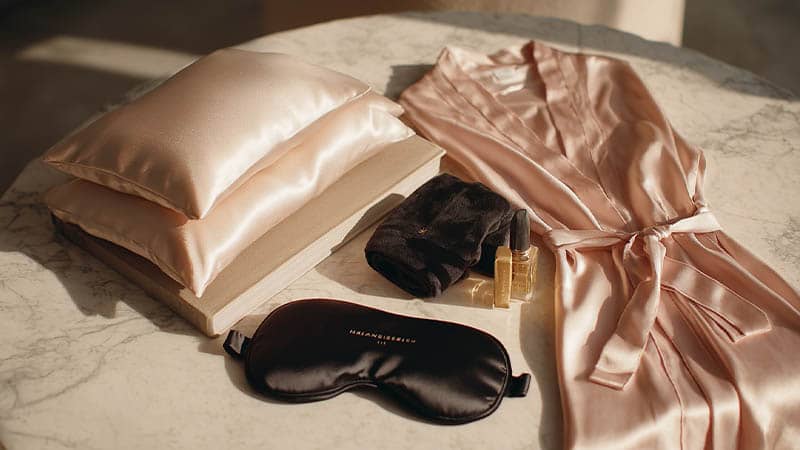
- Beauty silk pillowcases: 6A grade, 22–25 mm, 100% Mulberry, charmeuse weave—ideal for premium silk pillowcases.
- Silk Hair accessories: 5A–6A grade, 19–22 mm for scrunchies and silk bonnets with gentle elastic.
- Silk Blouses and slips: 6A grade, 16–19 mm, crepe de chine or satin depending on drape.
- Silk Robes and pajamas: 6A grade, 19–22 mm, twill for structure or satin for gloss when designing silk robes.
- Silk Eye masks: 5A–6A grade, 19–22 mm, double layer with blackout interlining for a comfortable silk sleep mask.
Tip: If your brand promise is “anti-frizz, anti-crease,” prioritize 6A + 22–25 mm for face and hair contact.
Ask for Quote Now
How To Specify Silk Clearly In Your POs
Include these fields in every purchase order and spec sheet:
- Silk species and source: 100% Mulberry, Bombyx mori, long-filament.
- Grade: 5A or 6A (reject “A+” without lab data).
- Momme: Target mm with tolerance (e.g., 22 mm ± 0.5).
- Weave: Charmeuse/satin, twill, crepe de chine, or habotai.
- Yarn: 20/22D, filament grade stated, twist direction S/Z if relevant.
- Finish: Degummed level, calendaring, enzyme wash, colorfastness grade.
- Color: Pantone TCX/TPG code; lab dip approval required.
- Width and shrinkage: e.g., 114–140 cm; residual shrinkage ≤3% after wash.
- Hand feel: Low slub count, even luster, smooth face.
- Compliance: AZO-free, OEKO-TEX Standard 100, REACH for EU.
- Labeling: “100% Mulberry Silk, momme XX, grade 6A, charmeuse.”
- Packaging and care: Folding, care labels, and polybag specs.
How To Validate Grade And Momme

Do not rely on invoices alone. Verify with measurable tests.
- Momme check: Weigh a cut sample with known dimensions; confirm via mm and GSM.
- GSM cross-check: 22 mm ≈ 90–95 GSM for charmeuse (varies by weave).
- Grade validation: Microscopy for filament uniformity, slub counts, and denier variation.
- Colorfastness: ISO 105/X12 rub, ISO 105/C06 wash—aim for grade 4+.
- Tear and tensile: ASTM D2261/D5035; higher mm should test stronger.
- Chemical safety: OEKO-TEX or third-party certificates per batch.
Charmeuse, Twill, Or Crepe: Which Weave Should YOU Choose?
- Charmeuse/Satin: Glossy face, perfect for pillowcases and luxury apparel; pair with 22–25 mm for durability.
- Twill: Diagonal ribs, balanced drape and strength; ideal for robes or heavier garments at 19–22 mm.
- Crepe de Chine: Matte, pebbly texture, excellent drape; often 12–16 mm for apparel.
- Habotai: Lightweight plain weave; use 8–12 mm for linings rather than bedding.
Match weave to use-case, then dial in grade and mm.
When Should YOU Pay For 6A Over 5A?
- If products touch face/hair and you market anti-frizz/anti-crease benefits.
- If you sell light pastel palettes where specks show easily.
- If your listings rely on macro photography.
- If returns mention snagging or roughness.
Otherwise, 5A at a higher mm can be more cost-effective for structural pieces.
Ask for Quote Now
Cost Optimization Without Quality Compromise
- Start with 5A, 22 mm for pillowcases; upgrade to 6A for hero SKUs.
- Balance S/Z twist to reduce snagging instead of jumping a full mm tier.
- Lock realistic tolerances: mm ± 0.5, width ± 1 cm, color ΔE ≤ 1.0.
- Place blanket POs to stabilize filament supply; negotiate wastage allowances.
- Approve strike-offs and counter-samples before bulk.
Red Flags That Risk Your Brand
- “30 momme pillowcases” at bargain prices—often blended or over-calendared.
- “6A A+ Ultra Grade” without yarn-lot traceability or lab data.
- Thin hand feel for claimed mm—signals low pick density or degumming variance.
- Excessive skew, bow, or needle marks—process control issues that drive returns.
Sampling And QC Checklist You Can Use
- Require three lab dips and approve under D65 light.
- Receive A4 swatches from loom-state and finished fabric.
- Verify mm by weighing two pieces from different edges.
- Wash test: 40°C gentle, air dry; record shrinkage and colorfastness.
- Inspect via the 4-point system; set a reject threshold (e.g., 28 points/100 yd²).
- Approve care label instructions on your trims and packaging.
How To Communicate Specifications To Suppliers
Send a one-page tech pack that leaves no room for interpretation.
- Product: “Queen pillowcase 50×75 cm with 10 cm envelope.”
- Fabric: “100% Mulberry Silk, Grade 6A, 22 mm ± 0.5, Charmeuse, width 114 cm.”
- Color: “Pantone 11-0602 TCX Snow White; ΔE ≤ 1.0 to master.”
- Performance: “Colorfastness to washing ISO 105/C06 A2S ≥ Grade 4.”
- Safety: “OEKO-TEX Standard 100 Class II certificate per batch.”
- Packaging: “Flat fold, tissue interleave, barcode label outside poly.”
- AQL: “AQL 1.5 Critical/2.5 Major/4.0 Minor; 4-point fabric inspection.”
Private Label Compliance And Claims
If YOU market benefits (anti-frizz, hypoallergenic), ensure claims are substantiated.
- Anti-frizz/crease: Support with abrasion and hair-glide tests.
- Hypoallergenic: Avoid formaldehyde finishes; request chemical reports.
- Label fiber content and origin to match your market laws.
How To Brief Your Marketing Team
- Translate specs into benefits: “22 momme, Grade 6A” becomes “Thicker, longer-lasting silk that reduces friction on skin and hair.”
- Shoot macro photos to show weave and luster on products like silk scarves.
- Publish a care guide: Gentle wash, pH-neutral detergent, air dry out of sun.
Frequently Asked Misconceptions
- “Higher momme always equals higher quality.” False—heavier fabric isn’t always better; fiber grade still matters.
- “6A is mandatory for everything.” Not always; align with use-case and price point.
- “You can feel momme by hand.” Estimate, but always weigh and test to be sure.
Ask for Quote Now
Recommended Baseline Specs By Category
- Beauty pillowcases: 6A, 22–25 mm, charmeuse, OEKO-TEX.
- Travel pillowcases: 5A, 19–22 mm, charmeuse, lighter pack weight.
- Eye masks: 5A–6A, 19–22 mm, double-layer, black interlining.
- Apparel slips and silk pajamas: 6A, 16–19 mm, crepe de chine for drape.
- Robes: 6A, 19–22 mm, twill or satin for structure and gloss.
Your Next Step: Lock Quality And Margin Now
Ready to turn these specs into sell-through? Fill out the inquiry form or contact us today for a tailored quote. YOU will get a custom spec sheet, two production-ready fabric options tailored to your price point, and a free pre-production testing plan. Move now to secure filament allocation, reduce lead times, and launch with confidence.
Request your custom quote and sample kit now.
Get final pricing within 48 hours and lab-tested swatches within 7–10 days.
Scale with a supplier who speaks your language—grades, momme, and ROI.