
What Makes A Silk Supplier Suitable For Small And Growing Brands?

Choosing the right silk supplier can decide how smoothly your brand moves from idea to finished product. If you are a small or growing brand, you may not need the largest factory. You need a supplier who understands flexible order quantities, clear product development, quality control, custom branding, and realistic production planning.
This guide explains what makes a silk supplier suitable for small brands and how you can evaluate one before placing an order. You will learn what to check in MOQ, OEM/ODM support, fabric selection, sampling, packaging, inspection, cost control, and long-term scalability. If you are planning custom silk products for a fashion, beauty, bedding, hotel, spa, Shopify, Amazon, or private label brand, this article will help you make a more confident sourcing decision.
Why Does The Right Silk Supplier Matter For Small Brands?
When you are building a brand, every order matters. A delayed shipment, wrong color, poor sewing detail, or inconsistent size can affect your launch plan, customer reviews, and cash flow.
A suitable silk supplier does more than produce goods. They help you reduce risk before bulk production begins. They explain fabric options, sample requirements, production limits, packaging choices, and inspection standards clearly.
For small brands, the right supplier should support both trial orders and repeat orders. You need a partner who can help you test the market first, then scale production when your sales grow.
The best silk supplier for small brands is not always the cheapest one. It is the one that helps you protect quality, control cost, and build products your customers want to buy again.
What MOQ Should You Expect From A Silk Supplier?
MOQ, or minimum order quantity, is one of the first questions most buyers ask. For a small brand, a reasonable MOQ gives you room to test products without holding too much inventory.
A flexible MOQ usually depends on product type, fabric availability, color choice, logo method, and packaging requirements. For example, stock fabric colors may allow lower quantities, while custom-dyed silk or special prints often require higher quantities.
If you are testing silk pillowcases, eye masks, bonnets, scrunchies, or simple accessories, your supplier may be able to offer smaller trial quantities. For silk pajamas, robes, dresses, or shirts, MOQ may be higher because cutting, sizing, trims, and sewing require more preparation.
You should ask your supplier: “Can I start with a small batch silk manufacturing order and reorder later?” This helps you understand whether the factory can support your current stage and future growth.
Ask for Quote Now
How Do OEM And ODM Silk Services Support Your Brand?
Before choosing a supplier, you should understand whether you need OEM or ODM support. Both can be useful, but they serve different needs.
OEM silk manufacturing is suitable when you already have your own design, tech pack, size chart, logo, packaging idea, and product specifications. The supplier produces according to your confirmed requirements.
ODM silk manufacturing is better when you have a product idea but need help with fabric selection, structure, pattern development, size suggestions, trims, or packaging direction.
For a new silk brand, ODM support can save time because the supplier helps turn your concept into a workable product. For a more established brand, OEM production may give you more control over details.
A suitable silk supplier should explain which solution fits your project instead of using the same process for every order.

Comparison: OEM Vs ODM Silk Manufacturing
Item | ODM Silk Manufacturing | |
Best For | Brands with complete designs | Brands with ideas or references |
Buyer Provides | Tech pack, specs, logo, packaging details | Concept, target market, product direction |
Supplier Supports | Production, sampling, quality control | Product development, design improvement, production |
Flexibility | High control over final product | More factory guidance |
Suitable For | Established brands and repeat orders | Startups and new product launches |
This comparison helps you decide which production model is more practical before you request a quotation.
Does The Supplier Understand Different Silk Fabrics?
A professional silk supplier should not recommend the same fabric for every product. Different silk fabrics create different handfeel, drape, thickness, shine, and performance.
Silk charmeuse is often used for pajamas, robes, pillowcases, eye masks, bonnets, and scrunchies because it feels smooth, soft, and elegant. It is one of the most common choices for premium sleepwear and beauty accessories.
Silk crepe de chine is useful for blouses, dresses, and garments that need a softer matte surface. Silk chiffon works well for light scarves and sheer designs. Silk twill is popular for scarves because it has structure and good print performance.
A suitable supplier should also explain alternatives such as silk habotai, silk jacquard, silk organza, silk georgette, silk stretch, silk velvet, and silk blends. If your collection includes cotton, linen, Tencel, bamboo, or imitation silk satin products, the supplier should help you compare comfort, cost, and market positioning.
Good fabric advice prevents you from choosing a material that looks attractive but does not match the real use of the product.
What Should You Know About The Sampling Process?
Sampling is one of the most important steps in custom silk product development. It allows you to check the product before committing to bulk production.
A clear sampling process should include fabric confirmation, size review, logo placement, sewing details, trims, packaging, and overall product appearance. For garments, this may also include pattern making and fit adjustment.
You should ask how long the silk product sampling process takes and what information the supplier needs from you. A reliable factory will tell you whether they need measurements, artwork files, Pantone colors, reference samples, label files, or packaging dimensions.
A pre-production sample may also be needed before bulk production. This sample confirms the final version that the factory will follow during mass production.
Sampling may take extra time, but it helps you avoid expensive mistakes later.
What Quality Control Should A Silk Supplier Provide?
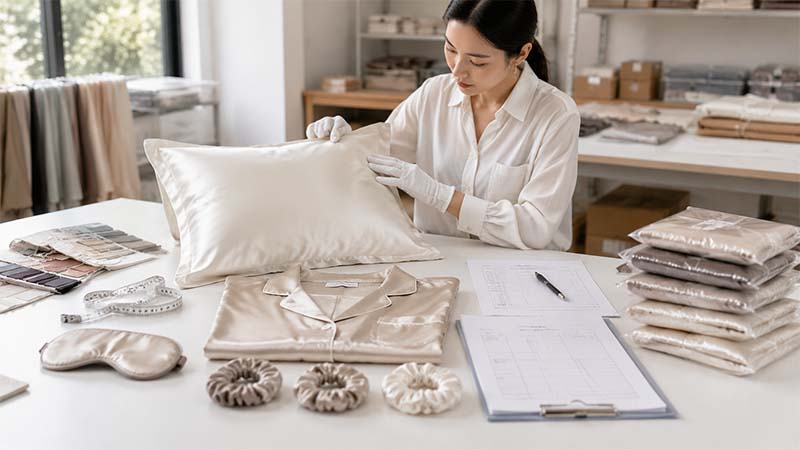
Quality control is essential for custom silk orders. Your customers may not know technical production terms, but they will notice stains, loose threads, uneven seams, weak elastic, poor finishing, or damaged packaging.
A suitable silk supplier should inspect fabric before cutting, check semi-finished products during sewing, and review finished products before shipment. For silk garments, inspection should include measurements, seams, hems, trims, buttons, piping, and overall appearance.
For pillowcases, eye masks, bonnets, and scrunchies, inspection may include fabric defects, filling, elastic recovery, zipper or envelope closure, logo position, stitching quality, and packaging condition.
You should also ask how defects are handled. A reliable supplier should repair, replace, or sort defective products before shipment instead of sending them to you without control.
Strong quality control helps small brands avoid returns, bad reviews, and customer complaints.
Checklist: What To Ask A Silk Supplier Before Ordering
Use this checklist when you compare silk suppliers or request a quotation:
- What is the MOQ for this product and fabric?
- Can you support small trial orders or repeat orders?
- Do you provide OEM, ODM, or both?
- What silk fabrics do you recommend for this product?
- Can you make samples before bulk production?
- How long does sampling and production usually take?
- Can I customize size, color, logo, label, and packaging?
- What quality control steps do you use before shipment?
- How do you handle defective products?
- Can you support my brand if order quantities grow later?
This checklist helps you move beyond price and evaluate whether the supplier can support your real business needs.
Can The Supplier Support Custom Branding And Packaging?
Custom branding helps your products look more professional and retail-ready. A suitable supplier should support private label options such as woven labels, care labels, hang tags, logo printing, embroidery, branded pouches, cards, and gift boxes.
If you sell online, packaging should protect the product and keep shipping costs under control. If you sell through retail, spa, hotel, or gift channels, packaging may need a more premium presentation.
You should ask what custom silk products with logo options are available and which methods work best on your chosen fabric. Some methods are better for garments, while others work better for pillowcases, eye masks, or accessories.
Good packaging should improve perceived value without creating unnecessary cost. A supplier who understands this can help you build a more consistent brand image.
How Can A Supplier Help You Control Cost?
Many small brands want to reduce cost, but the lowest price is not always the safest choice. A very low quotation may hide problems in fabric quality, sewing, inspection, packaging, or communication.
A suitable silk supplier should explain what affects the price. Common factors include fabric type, momme weight, order quantity, dyeing method, printing method, trims, sewing complexity, packaging, inspection level, and shipping method.
They may help you lower cost by using available fabric colors, simplifying packaging, combining products into sets, choosing practical trims, or adjusting product construction.
The goal is not to remove important quality details. The goal is to spend your budget where it matters most to your customers.
Good cost control protects both your margin and your brand reputation.
How Do You Know If A Silk Supplier Can Scale With You?
Your first order may be small, but your supplier should be able to support future growth. This is especially important if you plan to build seasonal collections, gift sets, hotel supply, Shopify stores, Amazon products, or retail channels.
A scalable supplier keeps clear records of approved samples, size charts, fabric details, logo files, packaging specifications, and production notes. This makes repeat orders faster and more consistent.
They should also be able to support more product categories as your brand expands. For example, you may start with silk pillowcases and scrunchies, then add eye masks, bonnets, robes, pajamas, camisoles, scarves, or bedding sets.
If every repeat order feels like starting over, the supplier may not be organized enough for long-term cooperation.
A good supplier grows with your brand instead of only completing one order.
What Product Range Should A Silk Supplier Offer?
A broad product range is helpful when you want to create a complete silk collection. It allows you to keep fabric color, logo style, sewing quality, and packaging more consistent across different products.
At Silkua, common custom product categories include silk shirts, silk blouses, silk dresses, silk pajamas, silk robes, silk camisoles, silk lingerie, pillowcases, eye masks, bonnets, scrunchies, bed sheets, silk scarves, headbands, and heatless hair curlers.
A supplier who can produce both silk apparel and silk accessories gives you more flexibility when planning bundles, gift sets, and private label collections.
This is useful for fashion brands, beauty brands, salons, spas, hotels, corporate gift buyers, Amazon sellers, and Shopify store owners.
The right product range helps you launch more SKUs with less supplier management pressure.
What Are The Main Signs Of A Reliable Silk Supplier?
A reliable silk supplier should be transparent, organized, and practical. They should not only say “yes” to every request. They should explain what is possible, what may increase cost, and what may affect lead time.
You should look for clear quotations, realistic timelines, fabric suggestions, sample support, quality control, custom packaging options, and written confirmation of key details.
It is also helpful if the supplier has experience with private label silk products and can support different buyer types, such as fashion startups, bedding brands, beauty brands, hotel groups, and e-commerce sellers.
A reliable supplier helps you avoid confusion and make better sourcing decisions.
When the supplier communicates clearly before the order, the production process is usually easier to manage.
FAQ: Choosing A Silk Supplier For A Small Brand
What Makes A Silk Supplier Suitable For Small Brands?
A suitable silk supplier should offer flexible MOQ, OEM/ODM support, fabric guidance, sampling, quality control, custom branding, packaging options, and the ability to scale as your order volume grows.
Can Small Brands Order Custom Silk Products With Low MOQ?
Yes, many small brands can start with lower quantities by using stock fabric colors, simple logo methods, standard packaging, or mixed product combinations. Custom dyeing, complex printing, and luxury packaging usually require higher MOQ.
What Should You Ask A Silk Manufacturer Before Placing An Order?
You should ask about MOQ, sample cost, fabric options, production lead time, logo methods, packaging choices, quality control process, payment terms, shipping options, and defect handling.
Is OEM Or ODM Better For A New Silk Brand?
ODM is often better if you need development support from an idea or reference sample. OEM is better if you already have a complete design, tech pack, size chart, logo, and packaging requirements.
How Can A Silk Supplier Help A Growing Brand Scale?
A silk supplier can help you scale by keeping approved samples, size specs, fabric records, logo files, and packaging details for repeat orders. They can also support new categories, larger quantities, and more consistent production planning.
Final Thoughts: Choose A Silk Supplier That Supports Your Next Stage
For small and growing brands, the right silk supplier is not only a manufacturer. They are a production partner who helps you move from idea to sample, from sample to bulk order, and from first launch to repeat sales.
You should choose a supplier who understands flexible MOQ, silk fabric selection, OEM/ODM development, sampling, quality control, branding, packaging, cost control, and scalable production.
If you are planning custom silk apparel, bedding, accessories, gift sets, or private label products, Silkua can help you develop and manufacture products that match your brand positioning and sales channel.
Contact Us today to share your product idea, request fabric suggestions, or get a custom quotation. Starting now helps you confirm samples earlier, reduce production risk, control costs, and prepare your next silk product launch with confidence.