
You want silk pajamas that look premium, feel secure, and last through wear—but you don’t want to inflate cost. This guide shows you how to use three trims—buttons, piping, and elastic—to lift perceived value and functional quality without breaking your target budget. You’ll learn which specifications matter, where to save versus spend, how to prevent common failures, and how to brief your manufacturer for a clean, on-time launch. Follow these practical guidelines to increase customer satisfaction, reduce returns, and strengthen your brand margin.
Table of Contents
Why Trims Decide 60% Of Perceived Quality
Buttons, piping, and elastic are the touchpoints your customer notices first. If buttons wobble, piping waves, or elastic twists, the garment feels cheap—even with 6A mulberry silk. By locking in the right trim specs, you improve:
- Visual sharpness: straighter seams, clean edges, even spacing.
- Functional reliability: secure closures, consistent fit after wash.
- Brand signature: contrast piping and custom button engraving that signal identity.
A trim strategy costs little compared with fabric upgrades but drives reviews, repeat buys, and higher AOV.
What “Quality Without Cost” Really Means
You don’t need exotic components. You need the right grades and controls:
- Spend where failure risk is highest (button security, waistband comfort).
- Save with stock color buttons and widely available sizes.
- Use process controls (stitch density and bartacks) instead of pricey materials.
This balanced approach keeps EXW stable while elevating customer experience and wholesale pricing power. If YOU work with Silk Clothing Manufacturers that follow these controls, you get premium results without premium bills.
Ask for Quote Now
Subscribe to Product Updates
Silk care tips and new arrivals — straight to your inbox.
Buttons: Materials, Sizes, And Attachment That Never Fail

Choose materials that match your positioning and use case:
- Resin/Polyester (Urea/Poly): durable, colorfast, cost-effective; best buttons for silk pajamas in mainstream lines.
- Mother-of-Pearl: premium feel and natural luster for boutique gift set silk pajamas.
- Metal: niche look; require nickel-free plating for sensitive skin and humid climates.
Size and profile:
- Tops/robes: 12–14L (7–9 mm) is versatile; cuffs 10–12L for a lighter look.
- Bottoms: 14–16L if using a fly; avoid bulky shanks that press skin.
- Low-profile, slightly domed forms reduce snagging on delicate fabrics.
Attachment and durability:
- Cross-stitch or lockstitch with heat-sealed thread ends.
- Shank height 1.5–2.0 mm for easy fastening over silk thickness.
- Hidden reinforcement button at the waistband stress point.
- Minimum 12–14 stitches per button; bartack at pocket corners and fly top.
Quality checks:
- Button pull test 10 kgf on random samples for chest and waist.
- Colorfastness of dyed buttons to ISO 105 so nothing bleeds onto ivory silk.
Button Cost Levers You Can Pull
Reduce cost without visible trade-offs:
- Use stock colors (ivory, black, navy) to avoid dye surcharges.
- Consolidate button sizes across styles for MOQ efficiency.
- Keep laser-engraved pajama buttons only on hero SKUs; plain resin on core.
- Confirm cavity count and surface finish early to avoid retool fees.
A 0.02–0.05 USD per button saving across sets compounds into stronger margins.
Piping: The Clean Edge That Signals Craft

Piping frames the garment and sharpens lines along collars, plackets, cuffs, and pockets. Practical constructions:
- Bias-cut silk piping: 45° cut with covered cord for smooth curves and soft handfeel.
- Satin or cotton piping: slightly stiffer, holds shape, cost-stable for larger runs.
Core specs:
- Cord diameter: 2.0–2.5 mm for classic look; 1.5–2.0 mm for delicate women’s sets.
- Stitch density: best stitch density for pajama piping is 8–10 SPI; keep even to avoid ripples.
- Seam allowance: 0.8–1.0 cm; underpress after joining for flat edges.
- Collar rolling: stay-stitch before applying piping to maintain curve.
Visual strategies:
- Contrast piping for silk pajamas (e.g., ivory on navy) as a brand signature.
- Self-fabric piping for subtle luxury and consistent color.
- Match thread to piping color for cleaner sightlines.
Piping Cost Control Without Looking Cheap
Save smartly:
- Use ready-made piping in standard colors to skip small-batch dyeing.
- Limit piping to high-visibility zones—collar, placket, cuff, pocket—and skip hems if needed.
- Keep one cord diameter across your collection to reduce changeover time.
Pressing discipline and consistent SPI improve perceived quality more than swapping to expensive trims.
Ask for Quote Now
Subscribe to Product Updates
Silk care tips and new arrivals — straight to your inbox.
Elastic: Comfort, Recovery, And Never-Twist Waistbands
The waistband is the comfort KPI of pajamas. Choose elastic that matches silk’s drape:
- Width: 3.0–3.5 cm for adult pants; 2.0–2.5 cm for slimmer women’s cuts.
- Type: Knitted elastic for soft hand and stable recovery; covered elastic for sensitive skin.
- Stretch and recovery: 2.0–2.2x elongation; ≥90% recovery after 500 cycles.
Construction tips:
- Fully enclosed elastic channels to avoid irritation.
- Two side seam anchors plus center-back stitch to stop rotation.
- Topstitch two rows (three if needed) to spread tension and prevent no-twist elastic issues.
- Add a flat drawcord for adjustability; bar-tack eyelets for durability.
Testing and care:
- Wash test at your care level (hand-wash or delicate machine) to verify elastic recovery.
- Heat setting elastic before assembly reduces post-wash shrink differential versus silk.
Elastic Cost Levers That Preserve Comfort
Keep comfort while saving:
- Choose stock widths and roll lengths from mainstream elastic suppliers.
- Avoid custom logo jacquard on inner waist for core lines; reserve for premium collections.
- Specify minimum elongation and recovery so QC can accept multi-supplier elastic specifications and secure better pricing.
Small unit savings on every waistband compound across volumes.
Color, Finish, And Brand Consistency Across Trims
You win when trims look unified:
- Color matching: target ΔE ≤ 1.0 under D65 between piping, buttons, and body fabric.
- Sheen balance: high-gloss resin with satin piping for classic sets; matte finishes with washed silk.
- Metal accents: document plating codes (light gold vs champagne) and require nickel-free metal where applicable.
Create a trims board—buttons, 2 mm pajama piping cord swatch, and waistband elastic—to guide sampling.
Stitching, SPI, And Bartacks That Save Returns
Lift durability by specifying process parameters:
- SPI: 10–12 for body seams in 19–22 momme; 8–10 for thicker 25 momme.
- Needle: size 9–11 microtex to prevent snagging delicate fibers.
- Thread: 60/3 polyester core-spun for strength and smoothness.
- Stress points: bartack pocket corners, fly top, and side vents.
- Seam type: French seams for high-end; overlock + topstitch for mid-tier efficiency.
These controls stop seam pops and keep pajama button size alignment consistent across plackets.
The Tech Pack: What To Include So Your Factory Gets It Right
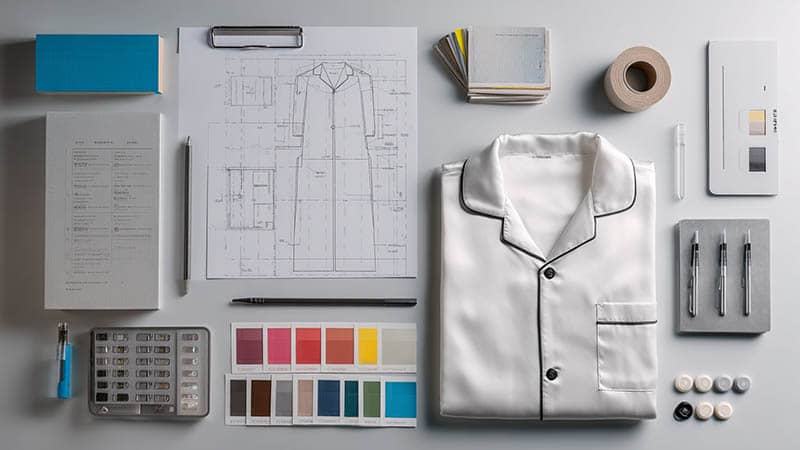
Your tech pack should be explicit and visual:
- Trim bill: button material, 12L–14L size, finish, stitch count, pull test value; piping type, cord dia., SPI; waistband elastic width, stretch ratio, recovery.
- Stitch maps: where to bartack, SPI per zone, topstitch rows at waist.
- Measurement table: relaxed and extended waist with tolerances and no-twist requirements.
- Color standards: Pantone for fabric and trims; plating codes for any metal.
- Care method: washing instructions that match trim durability.
A clear trims checklist for the tech pack compresses sampling rounds and lead time.
Ask for Quote Now
Subscribe to Product Updates
Silk care tips and new arrivals — straight to your inbox.
Quality Control: Simple Tests You Can Request
Low-cost QC prevents complaints:
- 10 kgf button pull test and cross-stitch integrity check.
- Piping alignment tolerance: ripples ≤3 mm per 30 cm on a flat table.
- Elastic recovery test: stretch to 2x for 30 seconds and require ≥90% return within 1 minute.
- Visual audit: button spacing variance ≤1 mm; topstitch rows parallel and even.
- Wash test: three-cycle test checking color bleeding, puckering, and waistband twist.
Add AQL inspection for sleepwear on bulk lots to standardize acceptance.
Costing Strategy: Where To Spend, Where To Save
Spend:
- Secure attachment and durable buttons.
- Comfortable waistband elastic that maintains recovery after wash.
- Consistent SPI and pressing along piping.
Save:
- Stock color buttons and unified sizes across styles.
- Limited contrast piping placements with the same cord diameter.
- Multi-supplier elastic specs to maintain pricing leverage.
This plan upgrades look and feel at minimal unit cost and supports competitive OEM/ODM service for custom silk pajamas.
Sustainability And Certifications That Matter
Maintain compliance without big premiums:
- OEKO-TEX Standard 100 for fabric and trims in skin-contact zones.
- Nickel-free finishes on any metal accents.
- Recyclable, mono-material packaging for retail.
State these in your product pages and buyer decks—clear claims improve trust and conversion.
How To Brief Your Manufacturer In One Email
Send a concise brief:
“19/22 momme 6A silk; contrast piping 2.0 mm cord, 8–10 SPI; resin buttons 12L with 14 stitches; waistband elastic 3.2 cm, 2.1x stretch, ≥90% recovery; bartack at pockets and fly; French seams for tops; overlock + topstitch for pants; OEKO-TEX trims.” You’ll get faster sampling, cleaner pricing, and fewer revisions from Silkua, a silk pajama manufacturer experienced in custom trims.
Get A Free Trim Review And Custom Quote
Ready to upgrade your silk pajama quality without raising cost? Share your artwork and current spec, and YOU will receive within 24 hours from Silkua:
- A free trims optimization report covering buttons, contrast piping, and waistband elastic.
- Three price tiers with lead times, MOQ guidance, and EXW/FOB options.
- A 1‑piece custom sample plan (sample fee deductible on order).
Request a custom quote now or upload your design for a free trims review with Silkua. Contact Us to lock a production slot this week and launch on schedule with sharper details, better fit, and stronger margins. Your customers will feel the difference on day one—so will your reviews.
Request An Instant Quote For Your Brand!
You May Also Find These Topics Interesting

Best Mulberry Silk Suppliers: How To Vet Factories And Avoid Middlemen
Best Mulberry Silk Suppliers:
OEM vs. ODM: Which Silk Pajama Production Solution Fits Your Business?
OEM vs. ODM: Which Silk Pajama