
If you plan to place a bulk textile order, auditing the factory first is one of the most effective ways to reduce sourcing risk. A proper audit helps you verify whether a supplier is a real manufacturer, whether its quality control process is reliable, and whether it can handle your required production capacity, lead time, and customization needs.
For buyers, importers, private label brands, and sourcing teams, the core question is simple: Can this factory consistently deliver the product I need at the quality level, timeline, and scale my business requires? This article answers that question directly. It explains what to check, how to compare suppliers, which warning signs matter most, and what buyers should ask before approving a textile manufacturer.
Table of Contents
Quick Answer: What Should You Check Before Approving a Textile Factory?
Before placing a bulk order, buyers should usually verify these seven areas:
Factory legitimacy
Confirm whether the supplier is a real factory or a trading company.Production capability
Check whether the factory has the equipment, workers, and workflow needed for your product type.Quality control process
Review how the supplier handles incoming materials, in-line inspections, and final checks.Fabric and material management
Evaluate how fabrics are stored, tested, identified, and controlled during production.Capacity and lead time
Make sure the factory can handle your expected volume within a realistic timeline.Documentation and compliance
Review business registration, testing reports, and any relevant certifications.Communication and problem-solving
Assess whether the supplier gives clear, specific, and technically accurate answers.
If a factory performs well in these areas, it is more likely to be a reliable partner for bulk textile production.
Why a Textile Factory Audit Matters
A factory audit is not only a compliance exercise. It is a decision-making tool. Many sourcing problems begin because buyers choose a supplier based only on price, sample appearance, or sales communication. In practice, the real issues often appear later: unstable quality, missed lead times, unclear responsibilities, poor packaging, or weak process control.
A structured audit reduces those risks. It helps buyers move from assumptions to evidence. Instead of asking whether the supplier sounds professional, you are checking whether the factory actually has the systems, people, and operational discipline required for consistent bulk production.
This is especially important for custom textile products, private label programs, and premium materials such as silk. The more specific your product requirements are, the more important supplier verification becomes.
Step 1: Define Your Order Requirements Before the Audit
Before evaluating any factory, clarify your own needs first. A supplier can only be judged accurately when your product expectations are clear.
At minimum, define:
- Product category
- Fabric type and composition
- Estimated order quantity
- Quality standards
- Labeling and packaging requirements
- Compliance needs for your target market
- Target lead time
- Customization details such as embroidery, printing, or branded packaging
This step matters because different factories have different strengths. A manufacturer that performs well for simple cotton basics may not be the right partner for silk sleepwear, gift-ready packaging, or highly customized private label production.
Ask for Quote Now
Subscribe to Product Updates
Silk care tips and new arrivals — straight to your inbox.
Step 2: Verify Whether the Supplier Is a Real Factory
One of the most common buyer concerns is whether the supplier is an actual manufacturer or only a middleman. This is a practical question, not just a legal one. If the company does not control production directly, quality issues and delivery problems may be harder to resolve.
To verify factory legitimacy, check:
- Company name consistency across quotations, invoices, certificates, and registration records
- Registered business scope
- Factory address and production site details
- Photos or videos of real production areas
- Whether the supplier can clearly explain its manufacturing workflow
During a factory visit, signs of a real textile manufacturer usually include fabric storage areas, cutting sections, sewing lines, inspection stations, pressing or finishing areas, and packing zones. The workflow should appear logical and active rather than staged only for presentation.
Step 3: Review the Production Facility and Workflow
The factory floor often reveals more than a sales presentation. A well-run facility does not need to be luxurious, but it should be organized, functional, and appropriate for the product you plan to order.
Key points to review include:
- Cleanliness and orderliness
- Layout of cutting, sewing, finishing, and packing areas
- Separation of raw materials, work-in-progress, and finished goods
- Equipment condition and suitability
- Worker coordination and line organization
- Handling of delicate or premium fabrics
For example, if you are sourcing silk products, the factory should be able to explain how it handles fabric protection, cutting accuracy, stain prevention, pressing, and final packing. A general answer is not enough. Buyers should look for process-specific details.

Step 4: Evaluate the Quality Control Process
If you ask only one technical question during a factory audit, it should be this: How do you control quality from raw material to finished product?
A reliable textile supplier should not depend only on final inspection. Strong quality control usually includes multiple checkpoints:
- Incoming material inspection
- In-process or in-line inspection
- Measurement and workmanship checks
- Final inspection before packing or shipment
Ask how the factory checks:
- Fabric shade consistency
- Stitching quality
- Sizing and measurement tolerance
- Label placement
- Packaging accuracy
- Defect recording and correction
Good answers are usually specific. Weak answers are often vague, such as “we check everything carefully.” Buyers should look for evidence of a real system, not only reassuring language.
Step 5: Assess Fabric and Material Control
In textile manufacturing, material control has a direct impact on product consistency. Even when sewing quality is acceptable, problems with fabric lots, shrinkage, color fastness, or mislabeling can lead to costly defects in bulk orders.
Buyers should ask:
- How are incoming fabrics identified and recorded?
- How do you check fabric composition and quality before cutting?
- How do you control color consistency across lots?
- How are delicate fabrics stored and protected?
- How do you reduce the risk of mixing materials between orders?
This part of the audit is especially important for premium fabrics, dyed materials, and customized orders with multiple colorways.
Step 6: Confirm Capacity, Lead Time, and Production Planning
A supplier may produce a strong sample but still fail at bulk execution. This usually happens when the factory lacks enough line capacity, has poor planning, or overloads production during peak periods.
To evaluate production reliability, ask:
- What is your monthly capacity for this product category?
- How many workers support this production line?
- What is your usual lead time for similar orders?
- How do you handle peak season scheduling?
- Do you subcontract any part of the production process?
- How do you manage sample approval to bulk order transition?
These questions help buyers understand not only what the supplier can make, but also how reliably it can deliver at scale.
Step 7: Check Documents, Reports, and Relevant Certifications
Documents do not replace an audit, but they are still important. They help confirm whether the supplier operates in a professional and traceable way.
Common items to review include:
- Business license
- Export documentation
- Testing reports
- Product compliance records
- Fabric performance reports
- Relevant social or quality certifications where applicable
The important point is relevance. Buyers do not need to collect every possible certificate. They need documents that match the product, market, and claims being made by the supplier.
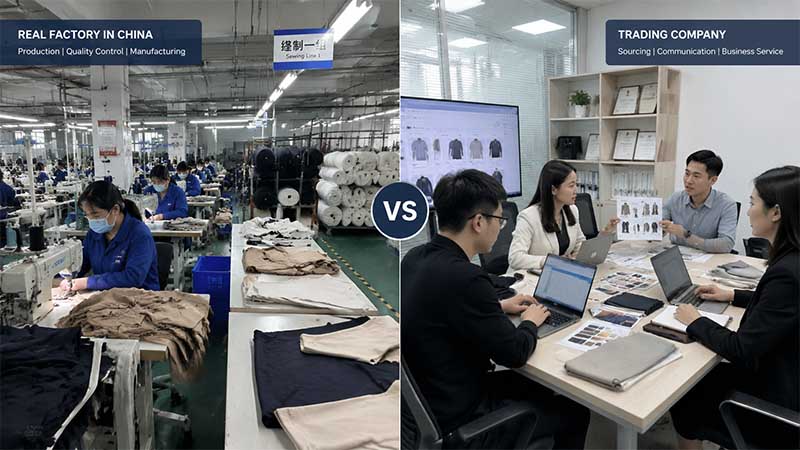
Comparison: Real Factory vs. Trading Company
For many buyers, one of the most useful comparisons is understanding the difference between a real factory and a trading company.
Area | Real Factory | Trading Company |
Production control | Direct | Indirect |
Communication with workshop | Faster | May be slower |
Problem resolution | Usually more direct | Depends on supplier network |
Price structure | Often more competitive | May include extra margin |
Product flexibility | Depends on in-house ability | May offer wider sourcing options |
Transparency | Easier to verify on-site | Sometimes less transparent |
Neither model is automatically wrong. However, buyers should know which model they are dealing with before placing a bulk order.
Textile Factory Audit Checklist for Buyers
Use this checklist before approving a supplier:
Basic Verification
- Is the company legally registered?
- Do company details match across documents?
- Is the production site real and active?
Production Assessment
- Does the factory make products similar to yours?
- Is the equipment suitable for your materials and construction?
- Is the workflow organized and easy to understand?
Quality Control Review
- Are there incoming, in-line, and final inspections?
- Can the factory explain defect handling clearly?
- Are quality standards documented and repeatable?
Material Control
- Are fabrics stored properly?
- Are lots and colors tracked correctly?
- Are delicate materials protected during production?
Delivery Reliability
- Can the factory meet your target volume?
- Is the lead time realistic?
- Is subcontracting involved?
Communication
- Are answers clear and specific?
- Does the team understand your customization needs?
- Do they ask relevant technical questions?
Common Red Flags Buyers Should Not Ignore
Some sourcing risks become obvious only when buyers know what to look for. Common red flags include:
- The supplier avoids showing production areas
- Company information is inconsistent
- Quality control answers are vague
- Lead times sound unrealistic
- The supplier says yes to everything without asking technical questions
- Production areas appear disorganized or inactive
- Documents are outdated or not relevant to the actual product
A single issue does not always mean the factory is unsuitable. However, repeated gaps in transparency, process control, or technical understanding should be taken seriously.
FAQ: Questions Buyers Often Ask
What is the difference between a factory audit and a pre-shipment inspection?
Can I audit a textile factory remotely?
When should I audit a factory?
The best time is before confirming a large order and before mass production begins. Ideally, the audit happens after early communication and sample review but before final approval.
What should I ask a factory before placing a custom textile order?
Ask about material sourcing, quality control steps, sample development, production capacity, lead time, packaging capability, labeling support, and defect handling. For custom programs, process clarity is often as important as price.
How Silkua Helps Buyers Choose a Reliable Textile Manufacturing Partner
If you want a simple answer, here it is: a good textile factory audit should confirm legitimacy, production capability, quality control, material management, capacity, documentation, and communication quality before you place a bulk order.
Buyers who review these areas carefully are usually in a much stronger position to avoid delays, reduce quality risk, and choose a supplier that can support long-term growth.
If you are sourcing silk products, sleepwear, accessories, bedding, or other custom textile items, Silkua, a China-based silk finished product manufacturer, provides OEM, ODM, private label, and custom manufacturing services for global clients. In practice, the most reliable partner is rarely the one offering the lowest quote alone. It is the supplier that can explain its process clearly, prove its capabilities, and deliver consistently at scale.
Request An Instant Quote For Your Brand!
You May Also Find These Topics Interesting
Silk Sleep Mask Pattern Design Guide: From Minimalist to Luxury Styles
Silk Sleep Mask Pattern Design

How To Negotiate Silk Manufacturing Prices Without Sacrificing Quality
How To Negotiate Silk Manufact

Is Silk or Satin Pillowcase Better? – Why Silk is the Best Choice for Your Business
Is Silk or Satin Pillowcase Be