

Luxury packaging can strengthen your silk brand, improve product protection, and create a memorable unboxing experience. However, expensive materials and complicated structures do not always deliver better results. An oversized rigid box, unnecessary insert, or excessive decorative finish can quickly increase your unit cost, storage needs, and international freight charges.
This guide explains how you can choose custom packaging for silk products without making your presentation look cheap. You will compare folding cartons, rigid gift boxes, pouches, sleeves, inserts, and other practical options. You will also learn how packaging MOQ, customization methods, sales channels, dimensional weight, and assembly labor affect your total cost. A step-by-step process, approval checklist, and FAQ will help you make a commercially sound decision.
Table of Contents
What Should Luxury Silk Packaging Accomplish?
Luxury silk product packaging should protect the item, communicate brand value, and make storage, delivery, and opening convenient. It does not need to be heavy or complicated.
Protection should be your first consideration. The package must keep silk clean, dry, smooth, and secure during production, shipping, retail handling, and storage.
Presentation is equally important. The colors, materials, typography, and structure should support the silk product’s quality and target price without overwhelming it.
Your packaging should also be practical. Customers should be able to open, reuse, recycle, or dispose of it without unnecessary effort.
How Much Should You Budget for Silk Product Packaging?
Start with your target retail or wholesale price and calculate backward. Your maximum packaging budget should support your desired margin and landed-cost target.
Do not compare only the supplier’s price for a box or pouch. A complete packaging cost breakdown should include samples, inserts, labels, printing, assembly, quality inspection, export cartons, freight, and storage.
A low-cost box can become expensive if workers need several minutes to assemble it. A premium rigid box can also increase dimensional shipping weight because of its size.
Separate your decorative packaging budget from your shipping packaging budget. The inner package builds the customer experience, while the mailer or export carton prevents transit damage.
Ask for Quote Now
Subscribe to Product Updates
Silk care tips and new arrivals — straight to your inbox.
Which Packaging Types Are Best for Silk Products?
The best structure depends on product size, price, sales channel, order quantity, and required protection. A silk eye mask should not use the same packaging as a pajama set.
Packaging Type | Best For | Protection | Relative Cost | Shipping Efficiency |
Paper card or sleeve | Scrunchies and small accessories | Low | Low | Excellent |
Fabric pouch | Eye masks, scarves, and bonnets | Medium | Low–Medium | Excellent |
Folding carton | Retail and e-commerce products | Medium | Low–Medium | Excellent |
Window box | Accessories requiring visibility | Medium | Medium | Good |
Drawer gift box | Premium sets and sleepwear | High | High | Medium |
Magnetic rigid box | Luxury and corporate gifts | High | High | Low |
Collapsible rigid box | Premium e-commerce collections | High | Medium–High | Good |
Protective inner bag | Bulk orders and moisture protection | Low–Medium | Low | Excellent |
You need the least complicated structure that provides sufficient protection and supports your intended brand position.
How Should You Match Packaging to Each Silk Product?
Silk eye mask packaging can include a paper card, folding carton, satin pouch, or compact drawer box. A rigid box is generally unnecessary unless the eye mask is part of a premium gift set.
Silk pillowcases need protection from moisture, dust, and handling but rarely require a deep box. A slim folding carton, fabric pouch, or shallow gift box usually provides enough space.
For silk pajamas and robes, you need a structure that accommodates the product without excessive compression. Folding cartons work for standard collections, while rigid gift boxes suit bridal and holiday ranges.
Silk scrunchie packaging can remain simple. A branded card, sleeve, pouch, or small carton can create a polished retail presentation without adding unnecessary weight.
Scarves require careful folding to reduce creasing. A shallow box, envelope-style package, or reusable pouch can protect the scarf while maintaining an elegant appearance.

Is a Rigid Box or Folding Carton Better?
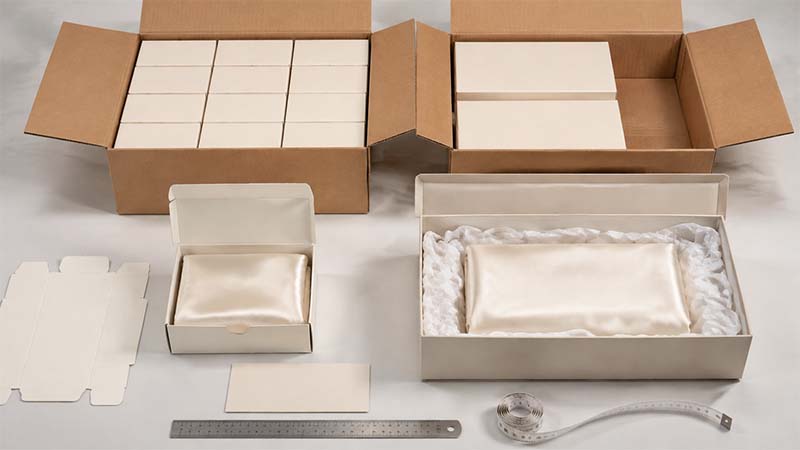
A folding carton is a lightweight paperboard box that normally ships flat and is assembled during packing. It offers printable retail packaging with lower storage and freight requirements.
A rigid box uses thicker board and is generally supplied assembled or as a collapsible structure. It provides stronger protection and a more substantial unboxing experience but costs more.
Feature | Folding Carton | Rigid Gift Box |
Perceived value | Moderate to high | High |
Structural strength | Moderate | High |
Unit cost | Lower | Higher |
Ships flat | Usually | Only if collapsible |
Storage requirement | Low | High if assembled |
Custom printing | Flexible | Flexible |
Best application | Retail and e-commerce | Premium gifting |
Choose a folding carton when you need cost-effective luxury packaging for retail or online sales. Choose a rigid box when the product is gift-oriented or has a high enough selling price to justify the additional cost.
When Is a Rigid Gift Box Worth the Extra Cost?
A rigid gift box is worth considering when your product requires a strong gifting experience, premium positioning, or additional structural protection.
It can be suitable for silk pajama sets, bridal robes, corporate gifts, limited collections, and coordinated silk pillowcase gift sets.
Before choosing one, consider its freight and storage impact. Assembled rigid boxes occupy considerable space, even when they are empty.
A collapsible rigid box may reduce shipping volume while maintaining a premium appearance. However, you should include assembly time and magnetic components in your total cost calculation.
How Does Your Sales Channel Affect Packaging?
Retail packaging often needs a barcode area, product information, hanging structure, and tamper-resistant features. It must remain attractive after repeated handling in a store.
E-commerce packaging for silk products should be compact and resistant to crushing. A beautiful gift box provides little value if it arrives scratched or dented.
Amazon and other fulfillment channels may calculate fees based partly on package dimensions. Smaller packaging can reduce shipping and fulfillment costs if it still protects the product properly.
Hotels, spas, and salons usually prioritize efficient handling, storage, and presentation. A branded sleeve or reusable pouch may be more practical than an elaborate box.
Corporate and holiday gifts benefit more from a refined unboxing experience. Drawer boxes, magnetic boxes, message cards, and coordinated inserts may justify their additional cost in this channel.
Which Materials Look Premium Without Costing Too Much?
Well-designed paperboard can make affordable luxury product packaging look refined. You can use uncoated, textured, matte, soft-touch, or subtly coated papers to create different effects.
Standard materials can look premium when they have accurate construction, clean typography, consistent colors, and well-controlled logo placement.
A satin pouch offers lightweight, reusable packaging for silk accessories. If you use satin to package genuine silk, clearly identify the pouch material to avoid confusing customers.
Small details such as tissue paper, belly bands, ribbons, or printed cards can upgrade a standard box. These additions may provide more value than increasing the board thickness.
Avoid selecting materials based only on photographs. Request physical samples because color, texture, stiffness, and surface quality may look different on a screen.
Which Customization Methods Offer the Best Value?
One-color or two-color logo printing is usually more cost-effective than a full-surface pattern. A simple design can still appear luxurious when the proportions and placement are correct.
Foil stamping produces a reflective finish, while embossing and debossing add physical texture. You do not need to combine all three methods to create premium packaging.
Spot UV and soft-touch lamination can highlight certain areas, but they add production steps and may show scratches or fingerprints depending on the material.
For low-MOQ custom packaging, consider a standard box with a branded sticker, sleeve, ribbon, or card. You can move to fully printed packaging after verifying demand.
Your packaging design should remain recognizable even without expensive finishes. Brand color, typography, and consistent composition are usually more important than decorative complexity.
Do You Need a Custom Packaging Insert?
A custom packaging insert keeps your product in place and can improve the opening experience. However, not every silk product needs one.
Cardboard inserts are suitable for accessory sets and folding cartons. They are generally lightweight, printable, and easier to recycle than foam.
Molded pulp provides stronger support and can suit brands that want a natural presentation. Foam offers accurate positioning but may conflict with sustainability goals.
Before adding an insert, ask whether the product could become damaged or unattractive without it. Tissue paper, a paper band, or a shaped card may provide sufficient control at a lower cost.
Test the insert with the actual product. An overly tight insert can compress, mark, or crease delicate silk.
How Can You Prevent Oversized Packaging?
Measure the finished and folded product before developing the packaging. Do not select box dimensions based only on an initial design or garment pattern.
The item should fit securely without excessive compression or empty space. Large gaps require more tissue, inserts, board, and shipping volume.
Request a plain structural sample before approving artwork. Place the real product inside and check the fit, opening experience, strength, and appearance.
If your collection contains several sizes, consider whether one box can accommodate them through adjustable inserts or different folding methods.
Reducing the number of packaging sizes can simplify inventory management. However, one oversized box for every product may cost more than maintaining two practical dimensions.
How Do Packaging MOQ and Unit Cost Work?
Custom packaging MOQ is usually separate from your silk product MOQ. Your product manufacturer may accept one quantity while the packaging supplier requires a larger production run.
Special dimensions, custom paper colors, metallic finishes, ribbons, magnets, printed patterns, and molded inserts can have separate minimum requirements.
Unit cost normally decreases as quantity increases because setup and development expenses are distributed across more packages. This does not mean you should automatically order the highest volume.
Unused packaging requires storage and can become obsolete if you change your logo, product dimensions, legal information, or barcode.
For trial orders, standard packaging with customized stickers or sleeves provides greater flexibility. It allows you to test your product before committing to a high-MOQ printed box.
How Can You Calculate the True Packaging Cost?
You should evaluate landed packaging cost rather than comparing only unit quotations. The lowest factory price may not produce the lowest total cost.
Include these expenses in your calculation:
- Structural and graphic design
- Plain and printed samples
- Boxes, pouches, cards, and sleeves
- Printing and decorative finishes
- Inserts, tissue, labels, and ribbons
- Assembly and packing labor
- Quality inspection and wastage
- Protective mailers and export cartons
- International freight and import charges
- Warehouse and inventory costs
Calculate how many retail packages fit into one export carton. Even a small box-size increase can reduce loading efficiency and raise your freight cost per unit.
How Can You Choose Silk Packaging Step by Step?
Follow these steps before approving custom silk product packaging:
Define Your Sales Channel. Identify whether the product is for e-commerce, retail, hotels, spas, subscriptions, or corporate gifting.
Set a Landed-Cost Target. Decide how much your product margin can support after materials, assembly, freight, and storage.
Measure the Finished Product. Fold the physical sample and record its practical dimensions.
Choose the Simplest Suitable Structure. Compare cards, sleeves, pouches, folding cartons, and rigid boxes.
Select Essential Branding. Decide whether you need printing, foil, embossing, stickers, ribbons, or branded cards.
Remove Unnecessary Components. Eliminate layers or finishes that do not improve protection, usability, or presentation.
Request a Structural Sample. Test the dimensions, product fit, opening method, and strength.
Approve a Printed Sample. Check colors, logos, wording, barcodes, care information, and surface finishes.
Complete a Packing and Transit Test. Evaluate assembly time, carton loading, drops, vibration, pressure, and shipping damage.
Document Your Specifications. Record dimensions, materials, artwork, tolerances, assembly methods, and inspection standards.
This process helps you select packaging based on measurable requirements rather than visual appeal alone.
What Should Your Packaging Approval Checklist Include?
Confirm these points before authorizing bulk packaging production:
- Does the package fit the finished product?
- Does it prevent dust, moisture, and handling damage?
- Is it strong enough for your distribution channel?
- Can your customer open it easily?
- Are the logo, colors, and typography accurate?
- Are product descriptions and care details correct?
- Is the barcode on a flat, scannable area?
- Does the product stay in place without excessive pressure?
- Is the insert necessary and correctly positioned?
- Does the package contain unnecessary empty space?
- Has the complete system passed a transit test?
- Is assembly fast enough for bulk packing?
- Does the MOQ match your sales forecast?
- Are sustainability claims accurate and supportable?
- Has the physical sample received written approval?
Retain one approved packaging sample and ask your manufacturer to keep another. Bulk production should be inspected against the same physical standard.
Which Packaging Mistakes Increase Your Costs?
Oversized packaging increases material consumption, insert requirements, export-carton volume, fulfillment fees, and warehouse space.
Using too many decorative finishes can also weaken the design. Foil, embossing, ribbons, magnets, windows, and special coatings do not automatically create greater perceived value.
Designing the package before confirming the product is another common mistake. Changes to filling, sizing, folding, or product combinations may make the package unusable.
Ordering large quantities before transit testing can lead to expensive losses. A box that looks attractive in a showroom may still arrive scratched, crushed, or open.
You should also avoid choosing a supplier based only on the lowest quote. Confirm the material specifications, board thickness, printing method, finishes, tolerances, and included services.
Frequently Asked Questions
What Is the Cheapest Packaging That Still Looks Premium?
A well-designed folding carton, paper sleeve, or fabric pouch can look premium at a reasonable cost. Clean branding and an accurate fit often matter more than heavy materials.
Does a Silk Eye Mask Need a Gift Box?
Not always. A pouch, paper card, or compact carton may be enough. A rigid gift box is more appropriate for premium sets and corporate gifts.
Should You Use a Box or Pouch for a Silk Pillowcase?
A pouch is lightweight and reusable, while a box provides more retail structure. Your choice should depend on the sales channel, product price, and required protection.
Can You Use One Box for Several Products?
Yes, if the products fit securely using appropriate folding methods or adjustable inserts. Standardizing dimensions can lower development and inventory costs.
Is a Satin Pouch Suitable for Genuine Silk Products?
Yes. A satin pouch can provide affordable reusable storage, but you should clearly describe the pouch material so customers do not mistake it for silk.
How Can You Lower Custom Packaging Costs?
Reduce package size, simplify printing, remove unnecessary inserts, standardize dimensions, choose flat-packed structures, and use stock packaging for trial orders.
What Should You Approve Before Bulk Production?
Approve the dimensions, structure, materials, artwork, colors, finishes, insert, wording, barcode, assembly method, carton loading, and physical sample.
How Can Silkua Help You Develop Cost-Effective Packaging?
The best luxury packaging is not necessarily the most expensive. It is the option that protects your silk product, fits your sales channel, communicates brand value, and stays within your landed-cost target.
Silkua can coordinate private-label packaging for silk pillowcases, eye masks, scrunchies, bonnets, scarves, pajamas, robes, and gift sets. You can compare pouches, folding cartons, drawer boxes, rigid gift boxes, inserts, printed cards, custom labels, and logo finishes.
Avoid committing to oversized or overdesigned packaging before you understand its full cost. Contact Us and complete the Silkua inquiry form today to receive practical recommendations and a customized quotation. Acting early helps you test the structure, improve shipping efficiency, and avoid expensive packaging changes after bulk production begins.
Request An Instant Quote For Your Brand!
You May Also Find These Topics Interesting
Best Mulberry Silk Suppliers: How To Vet Factories And Avoid Middlemen
Best Mulberry Silk Suppliers:

How to Customize Wholesale Silk Pajamas: A Guide for Fashion Brands
How to Customize Wholesale Sil

Private Label Silk Robes: Size Grading, Belt Placement, And Shrinkage Control
Private Label Silk Robes: Size