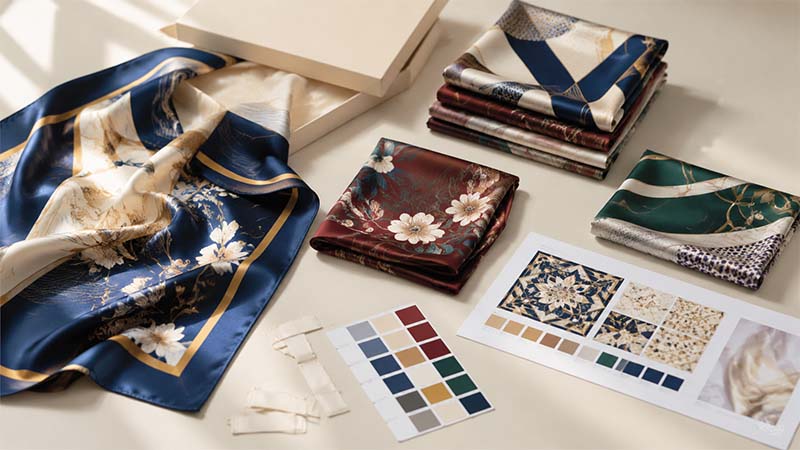
Quick answer: The minimum order quantity for custom silk scarves depends on the fabric, scarf size, printing method, number of designs, edge finishing, labels, and packaging. Digital printing is generally more suitable for small-batch production, while screen printing often requires a larger quantity to make setup costs economical.
A low minimum order can be useful for emerging brands, boutiques, corporate gift projects, museums, and designers testing a new collection. However, the lowest possible quantity is not always the most cost-effective choice. Understanding how a manufacturer calculates MOQ can help you select the right production method, control costs, and avoid unnecessary inventory.
Table of Contents
What Does MOQ Mean for Custom Silk Scarves?
MOQ stands for minimum order quantity. It is the smallest number of scarves a manufacturer can produce under a specific set of production requirements.
For custom scarf manufacturing, MOQ may be calculated according to:
- Each artwork or design
- Each colorway
- The selected silk fabric
- Scarf dimensions
- Printing method
- Edge-finishing technique
- Custom labels and packaging
For example, ordering 100 scarves in four different designs may not be treated in the same way as ordering 100 pieces of one design. Each artwork may require separate color management, fabric preparation, printing, cutting, and quality inspection.
For this reason, buyers should always ask whether the quoted quantity applies per design, per color, or to the total order.
What Is a Typical Custom Silk Scarf MOQ?
There is no universal MOQ that applies to every silk scarf project. The required quantity can range from a single prototype to hundreds of pieces per design.
Small orders are more practical when the product uses:
- Digital textile printing
- Standard silk fabrics
- Common scarf dimensions
- Machine-finished edges
- Standard labels or packaging
A higher minimum may apply when the project requires:
- Screen printing
- Custom-dyed fabric
- Multiple colorways
- Special scarf shapes
- Hand-rolled edges
- Bespoke woven labels
- Luxury gift boxes
- Complex double-sided printing
The most reliable way to confirm the quantity is to provide the manufacturer with complete product specifications instead of requesting a general MOQ without project details.
Ask for Quote Now
Subscribe to Product Updates
Silk care tips and new arrivals — straight to your inbox.
The printing method is one of the main factors affecting order quantity, unit price, color performance, and production time.
Factor | Digital Printing | Screen Printing |
Best suited for | Small and medium orders | Medium and large orders |
Artwork complexity | Detailed illustrations, gradients, and photographs | Solid colors and graphic patterns |
Number of colors | Usually flexible | Each color may require a separate screen |
Setup requirements | Relatively low | Higher due to screen preparation |
Small-batch flexibility | High | Limited |
Cost efficiency | Better for lower quantities | Better for larger repeat orders |
Color penetration | Depends on fabric and process | Can provide strong penetration with the correct process |
Design changes | Easier to manage | May require new screens |
Which printing method is better for a small order?
Digital printing is usually the more practical choice for small-batch custom silk scarves. It does not require a separate physical screen for every color, making it suitable for artwork with gradients, fine details, or many colors.
Screen printing can become cost-effective for larger orders, particularly when the artwork contains a limited number of solid colors. However, the setup involved may result in a higher minimum quantity.
The best option should be selected according to the artwork, expected color result, budget, and order volume—not MOQ alone.
What Factors Affect the Minimum Order Quantity?
1. Silk fabric and momme weight
Silk twill, charmeuse, crepe de chine, chiffon, and habotai have different structures, weights, print characteristics, and sourcing requirements.
Silk twill is frequently selected for premium square scarves because it provides structure and good print definition. Charmeuse has a smoother, more lustrous surface and a softer drape. Chiffon is lightweight and translucent, while crepe de chine offers a more understated appearance.
Momme describes the weight and density of silk. A heavier momme does not automatically mean a higher MOQ, but fabric availability and production requirements can affect the final quantity.
2. Scarf size
Standard dimensions are generally easier to produce than unusual sizes or shapes. Common options include:
- 45 × 45 cm
- 53 × 53 cm
- 65 × 65 cm
- 70 × 70 cm
- 90 × 90 cm
- Long scarves
- Twillies
- Triangular scarves
Scarf size also affects fabric consumption, printing layout, cutting, packaging, and the final price per piece.
3. Number of designs and colorways
A manufacturer may offer a low total quantity but still require a minimum number of pieces for each design.
If your order contains several color variations, confirm whether they can be combined under one production run. Minor color changes may appear simple, but they still require separate files, color checks, and quality control.
4. Edge finishing
The two most common options are machine hemming and hand-rolled hemming.
Machine hemming is consistent and efficient, making it suitable for commercial collections and lower production volumes. Hand-rolled edges provide a more artisanal appearance but require additional skilled labor and production time.
Edge finishing may not always change the base MOQ, but it can affect capacity, lead time, and unit cost.
5. Labels and packaging
Custom woven labels, care labels, hangtags, pouches, envelopes, and gift boxes may each have their own minimum quantities.
The packaging supplier’s MOQ can be higher than the scarf manufacturer’s production minimum. A project may therefore support a small scarf order but require a larger quantity of branded boxes.
For a first collection, standard packaging with a custom sticker, sleeve, or printed card may provide a more flexible alternative.
Can Multiple Designs Be Combined in One Order?
In some cases, multiple designs can be combined, but this depends on the production method and the quantity allocated to each design.
Before placing an order, ask the manufacturer:
- Is the MOQ based on each design or the total quantity?
- Can different colorways be combined?
- Must every design use the same fabric and size?
- Can one order include different edge finishes?
- Are labels and packaging calculated separately?
Using the same fabric, dimensions, finishing method, and packaging across several designs may make a mixed order easier to manage. However, every design must still meet the manufacturer’s technical production requirements.

How Much Do Custom Silk Scarves Cost?
The cost per piece is influenced by more than the order quantity. A complete quotation should consider:
- Silk type and momme weight
- Scarf dimensions
- Printing method
- Number of designs
- Number of colors
- Single- or double-sided printing
- Machine- or hand-finished edges
- Custom labels
- Retail packaging
- Sample development
- Quality-control requirements
- Shipping destination
Lower quantities usually have a higher unit cost because sampling, file preparation, color management, machine setup, and quality inspection must be distributed across fewer pieces.
When comparing quotations, check whether the price includes labels, packaging, sampling, shipping, import duties, and taxes. A low unit price may not represent the complete landed cost.
Steps for Ordering Custom Silk Scarves
Step 1: Define the product
Specify the intended scarf size, fabric, approximate momme weight, printing method, finishing, and target quantity.
If you are uncertain about the material, explain how the scarf will be used. A manufacturer can then recommend an appropriate fabric based on drape, appearance, durability, and budget.
Step 2: Prepare the artwork
Vector files are preferred for logos, borders, typography, and geometric designs. High-resolution raster files may be suitable for paintings, photographs, and detailed illustrations.
Artwork should normally include:
- Final dimensions
- Sufficient resolution
- Bleed area
- Color references
- Logo placement
- Border alignment
- Edge-finishing allowance
Ask for the manufacturer’s artwork template before finalizing the design.
Step 3: Request a detailed quotation
A useful quotation should clearly state:
- Quantity per design
- Sample cost
- Unit price
- Fabric specification
- Printing method
- Edge finishing
- Label and packaging costs
- Production lead time
- Shipping terms
This makes it easier to compare suppliers on equal terms.
Step 4: Approve a sample
A digital mockup can confirm placement and proportions, but it cannot fully demonstrate fabric texture, printed color, drape, or edge quality.
For a new design or supplier, a physical sample is recommended before bulk production. Depending on the project, this may be a print strike-off, a pre-production sample, or a complete finished scarf.
Step 5: Confirm bulk production details
Step 6: Conduct quality inspection
Finished scarves should be checked for printing defects, stains, inaccurate dimensions, uneven hems, damaged labels, and packaging errors.
Pre-Order Checklist
Use this checklist when requesting a quotation from a custom silk scarf manufacturer:
Product specifications
- Scarf dimensions are confirmed
- Silk fabric is selected
- Momme weight is specified
- Printing method is confirmed
- Edge finishing is selected
- Quantity per design is listed
Artwork and color
- Print-ready artwork is available
- File dimensions match the scarf size
- Bleed and hem allowances are included
- Pantone or other color references are provided
- Logo placement has been approved
Branding and packaging
- Main label requirements are confirmed
- Care label information is accurate
- Country-of-origin requirements are checked
- Hangtags or barcode labels are specified
- Retail packaging is selected
Production and delivery
- Sample type and cost are confirmed
- Bulk production time is stated
- Packaging lead time is included
- Quality standard is agreed upon
- Shipping terms and destination are confirmed
Providing this information at the beginning of a project helps the manufacturer calculate a more accurate quantity, price, and production schedule.
How Can You Reduce the MOQ?
If the initial quantity is higher than your project requires, consider simplifying the product rather than compromising quality.
Practical options include:
Choose digital printing.
It is generally more flexible for small quantities and multicolor artwork.Use an available silk fabric.
A standard fabric and momme weight may be easier to source than a custom-developed material.Keep one standard size.
Using the same dimensions across a collection can simplify production.Limit the number of designs.
Fewer designs allow more pieces to be allocated to each artwork.Use machine-finished edges.
This may reduce labor requirements and shorten production time.Simplify the packaging.
Standard boxes, envelopes, or pouches can be combined with custom cards or stickers.Plan repeat orders.
Testing one focused collection can provide useful sales data before expanding into additional sizes or colorways.
The objective should not be to obtain the lowest possible quantity at any cost. The better goal is to find a production structure that balances inventory risk, unit price, product quality, and future scalability.
Frequently Asked Questions
What is the minimum order quantity for custom silk scarves?
It depends on the fabric, size, printing method, number of designs, finishing, and packaging. Digitally printed scarves made with standard materials generally support smaller orders than screen-printed or highly customized products. Request a project-specific quotation for an accurate figure.
Is the MOQ calculated per design or per total order?
Many manufacturers calculate the minimum per design or colorway rather than across the total order. If you plan to order multiple designs, confirm how many pieces of each artwork are required.
Can I order a custom silk scarf sample before bulk production?
Yes. A physical sample is recommended when color accuracy, fabric quality, dimensions, and edge finishing are important. Ask whether the sample is a strike-off, an unfinished print sample, or a complete finished scarf.
Does the sample count toward the bulk-order quantity?
Usually, a development sample is handled separately from bulk production. Policies vary, so confirm whether the sample charge can be credited after a production order is placed.
Can different designs be mixed within one MOQ?
Some manufacturers allow mixed designs when they use the same fabric, size, printing process, and finishing. However, a minimum quantity per design may still apply.
Does scarf size affect MOQ?
Size may affect fabric usage, printing layout, cutting efficiency, and price. Standard dimensions are often easier to accommodate, while oversized scarves or unusual shapes may require a different minimum.
Do hand-rolled edges increase the MOQ?
Not necessarily, but hand rolling requires skilled labor and additional production time. It may increase the unit price or limit how quickly the order can be completed.
What is the best silk fabric for printed scarves?
Silk twill is a popular choice for structured square scarves and detailed prints. Charmeuse offers more shine and fluidity, while chiffon is lighter and more transparent. The best option depends on the desired appearance, drape, use, and budget.
What artwork files are needed for silk scarf printing?
Vector files such as AI, EPS, or editable PDF are preferred for logos and geometric artwork. High-resolution PSD or TIFF files may be used for paintings and photographs. Always request the factory’s size, resolution, bleed, and color requirements.
Can a manufacturer match Pantone colors on silk?
Pantone references can be used as color targets, but the final appearance may vary because silk has natural luster and absorbs ink differently from paper or a computer screen. A physical print sample should be approved when precise color matching is required.
How long does custom silk scarf production take?
Lead time depends on material availability, sampling, printing method, quantity, finishing, packaging, and production capacity. Ask for separate estimates for artwork review, sampling, bulk manufacturing, packaging, and shipping.
Do custom labels and gift boxes have separate MOQs?
They often do. Woven labels, printed care labels, pouches, and rigid gift boxes may be produced by different suppliers, each with its own minimum quantity. Confirm packaging requirements early to avoid delays or excess inventory.
Choosing the Right MOQ for Your Project
The right order quantity should support both your current sales plan and your long-term brand strategy. A small initial order can reduce inventory risk, but a larger production run may offer a better unit price.
Before choosing a quantity, consider:
- How many designs you plan to launch
- Your expected sales volume
- Target retail price
- Available storage space
- Packaging requirements
- Reorder schedule
- Marketing and sampling needs
A reliable manufacturer should explain how the quantity is calculated and identify which specifications are increasing it. With clear artwork, realistic product requirements, and an approved sample, you can select a production plan that protects quality without ordering more inventory than your business needs.
Request An Instant Quote For Your Brand!
You May Also Find These Topics Interesting
Custom Silk Robes: The Ultimate Luxury in Silk Fashion and Wholesale Markets
Custom Silk Robes: The Ultimat
Silk Robes OEM Guide: How to Create a Private Label Loungewear Collection
Silk Robes OEM Guide: How to C
The Best Fabrics for Nightcaps: Silk vs Satin vs Tencel for Comfort and Breathability
The Best Fabrics for Bonnets: