

Silk twill and silk charmeuse can both create premium custom scarves, but they deliver different results. Twill has a subtle diagonal texture, greater shape retention, and a classic appearance. Charmeuse has a smoother face, stronger luster, and a softer, more fluid drape.
Your choice affects how the scarf looks, ties, prints, wears, and performs during production. It can also influence reverse-side color, hem construction, durability, cost, and your final retail positioning. This guide compares both materials and explains how you can select the best silk fabric for scarves based on shape, artwork, customer expectations, and intended use. You will also find a step-by-step selection process, a production checklist, and answers to common sourcing questions.
Table of Contents
What Is Silk Twill Fabric?
Silk twill is a woven silk fabric recognized by fine diagonal ribs across its surface. The diagonal texture comes from the twill weave rather than from a printed pattern or surface coating.
This construction gives silk twill a stable hand and controlled drape. It usually retains folds and knots more clearly than soft satin-weave fabrics.
Silk twill scarf fabric is commonly used for square scarves, bandanas, neckerchiefs, twillies, and detailed printed accessories. It can communicate a classic, polished, and structured brand image.
However, not every twill has the same performance. Yarn quality, density, momme weight, finishing, and printing method can alter its softness, opacity, and durability.
What Is Silk Charmeuse Fabric?
Silk charmeuse is made with a satin-weave construction. It typically has a smooth, lustrous face and a less reflective reverse side.
The longer yarn floats on its face produce its recognizable shine and fluid movement. This allows charmeuse to form soft folds and drape closely around the neck, shoulders, or hair.
Silk charmeuse scarf fabric is often selected for long scarves, wraps, evening accessories, and headscarves. It also coordinates naturally with silk dresses, robes, camisoles, and sleepwear collections.
Charmeuse looks elegant and luminous, but its appearance changes with movement and lighting. The same printed shade may look lighter or deeper depending on the viewing angle.
What Is the Difference Between Silk Twill and Charmeuse?
Silk twill has a diagonal texture, greater structure, and stronger shape retention. Silk charmeuse has a smoother face, brighter luster, and more fluid drape.
The difference comes primarily from the weave. Twill uses staggered interlacing to create diagonal lines, while charmeuse uses a satin weave with longer face-side floats.
These constructions affect texture, shine, print appearance, sewing stability, snag sensitivity, and how a finished scarf forms knots.
You should compare physical fabric samples before choosing. Product photographs cannot accurately communicate hand feel, fabric weight, drape, or changes in reflected light.
Ask for Quote Now
How Do Silk Twill and Charmeuse Compare?
Use this comparison to identify which fabric better supports your scarf concept:
Decision Factor | Silk Twill | Silk Charmeuse |
Weave | Twill weave | Satin weave |
Surface | Fine diagonal texture | Smooth, lustrous face |
Drape | Structured and controlled | Soft and fluid |
Shine | Subtle to moderate | Moderate to high |
Shape retention | Higher | Lower |
Knot appearance | Defined and dimensional | Soft and compact |
Sewing stability | Easier to control | More likely to shift |
Common shapes | Square, bandana, twilly | Long scarf, wrap, headscarf |
Brand impression | Classic and polished | Flowing and glamorous |
These differences are general tendencies rather than fixed rules. A lightweight twill can feel soft, while a heavier charmeuse can provide more body.
Your final decision should also account for scarf dimensions, silk momme weight, finishing, printing, edge construction, and customer use.
Which Fabric Is Better for Printed Silk Scarves?
Silk twill is often preferred for structured printed scarves with detailed illustrations, borders, geometric patterns, lettering, and repeated motifs.
Its controlled surface can help defined design elements appear organized and balanced. This is particularly useful for square scarves where border alignment is visually important.
Charmeuse works well for artwork featuring gradients, flowing patterns, large color fields, and luminous decorative effects. Its smooth face can make colors feel rich and dynamic.
Neither fabric is automatically better for every printed scarf. You should approve a physical print strike-off on the exact fabric selected for production.
Which Fabric Produces Sharper Printed Details?
Silk twill can be a practical choice when your artwork contains fine lines, logos, complex borders, or small decorative elements. Its surface structure supports a defined, graphic appearance.
Charmeuse can also reproduce detailed artwork, but stronger reflections may affect how you perceive line definition from different angles.
The fabric alone does not determine silk scarf print quality. Artwork resolution, pretreatment, dye chemistry, printer calibration, steaming, washing, and finishing also influence the result.
If printed details are commercially important, request a full-size or representative strike-off. Review it at normal viewing distance instead of judging only through a close-up photograph.

Which Fabric Shows Printed Colors More Brightly?
Charmeuse often appears brighter because its smooth face reflects more light. This can give saturated colors and dark backgrounds greater visual depth.
Silk twill usually produces a more restrained appearance. Colors can still be rich, but the fine diagonal texture distributes reflected light differently.
A brighter appearance does not necessarily mean more accurate color matching. You should compare the printed sample with your physical color reference under agreed lighting conditions.
When exact brand colors matter, approve separate samples for twill and charmeuse. The same artwork and dye formulation may not look identical on both materials.
How Does the Reverse Side Affect Your Choice?
The reverse-side appearance matters because both sides of a scarf become visible when it is tied, folded, or worn in motion.
The amount of color penetration depends on fabric weight, weave, ink or dye system, pretreatment, artwork, and printing conditions. You should not assume that every single-sided print will have a white reverse.
A pale reverse may be more noticeable on narrow twillies, long scarves, and headscarves. Dark outlines and highly saturated artwork can make front-to-back differences more obvious.
Ask your manufacturer to show the front, back, folded edge, and finished knot. This provides a more realistic evaluation than viewing the printed face alone.
Is Single-Sided or Double-Sided Printing Better?
Single-sided silk scarf printing is usually more straightforward and cost-effective. The reverse may display a lighter version of the design when the dye penetrates the fabric.
Double-sided printing may provide stronger visual consistency when both sides remain visible. Depending on the method, it may allow similar or different artwork on each side.
However, double-sided effects can require more complex alignment, processing, or construction. They may also increase sampling requirements, cost, and production time.
You should choose based on how the scarf will be worn. A design that stays mostly flat may not require the same reverse-side quality as a twilly or long flowing scarf.
Which Fabric Has Better Drape?
Silk charmeuse generally offers a softer and more fluid drape. It forms smooth folds and moves naturally with the wearer.
This makes charmeuse suitable for long scarves, lightweight wraps, evening accessories, and products intended to create a flowing silhouette.
Silk twill has a more controlled drape and maintains recognizable folds. It is often better for square scarves, bandanas, neck scarves, and handbag accessories.
Weight and dimensions can change the result significantly. You should request a full-size prototype because a small fabric swatch cannot accurately demonstrate how a completed scarf hangs or ties.
Which Fabric Holds Its Shape Better?
Silk twill generally holds its shape better than charmeuse. Its diagonal weave gives the fabric more structure and helps knots remain defined.
A square twill scarf can be folded into a triangle, tied around a neck, or styled on a handbag without immediately losing its form.
Charmeuse creates softer knots and folds. It is appropriate when you want movement and fluidity instead of crisp styling.
If shape retention is one of your main selling points, test the scarf through repeated tying and unfolding. You should also check whether the fabric develops persistent creases.
Which Fabric Is More Durable?
Silk twill is generally more suitable when your customers will frequently fold, tie, and restyle the scarf. Its structure usually provides better resistance to everyday handling.
Charmeuse has longer yarn floats on its smooth face, making it more sensitive to snagging and visible abrasion. Jewelry, rough nails, and unpolished hardware can damage the surface.
Durability still depends on more than weave. Fiber quality, fabric weight, density, finishing, stitching, and care practices all affect performance.
You should conduct snagging, rubbing, colorfastness, and care tests based on the intended use. Any scarf rings, clasps, labels, or decorative components should also be tested against the fabric.
Which Fabric Is Easier to Cut and Sew?
Silk twill is usually more stable during spreading, cutting, folding, and hemming. This helps the factory maintain consistent dimensions and straight borders.
Charmeuse can move or distort during production because of its smooth, fluid construction. It requires controlled fabric relaxation, accurate grain alignment, and careful handling.
Suitable needles, thread, machine tension, pressing temperature, and skilled operators are essential for both fabrics. Incorrect settings can cause pulls, puckering, needle marks, or wavy edges.
You should inspect the finished corners, hems, dimensions, and border alignment before approving bulk production. Good printing cannot compensate for poor sewing quality.
Which Hem Is Best for Silk Twill and Charmeuse?
A rolled hem is a common edge finish for custom silk scarves. It protects the raw edge while preserving the fabric’s lightweight appearance.
A hand-rolled hem can support premium positioning and traditional craftsmanship. It also increases labor cost and production time, and natural variation should be expected.
A machine-rolled hem provides greater speed and consistency for wholesale silk scarves. Thread color, stitch density, hem width, and corner shape should be approved on a sample.
Both fabrics can use rolled hems. Twill generally creates a firmer edge, while charmeuse produces a softer and more delicate result.
What Is the Best Momme Weight for Silk Scarves?
There is no single best momme weight for every scarf. The correct weight depends on scarf size, weave, styling method, print coverage, season, and target price.
A lightweight charmeuse creates an airy, fluid accessory but may provide less opacity and structure. A heavier charmeuse offers more body but can feel bulkier in a small knot.
Heavier silk twill can deliver a substantial luxury feel and strong shape retention. However, it may be too firm for a narrow scarf or oversized wrap.
Your inquiry should specify more than “silk twill” or “silk charmeuse.” Include the required weight, dimensions, composition, finish, artwork, and intended use.
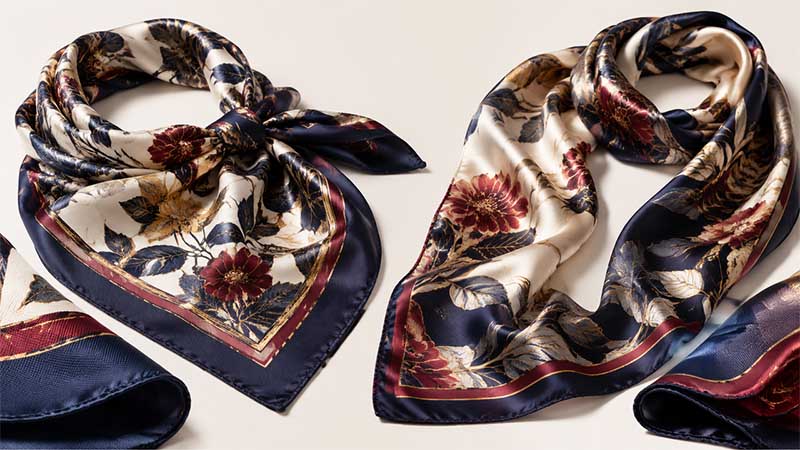
Which Fabric Is Best for Different Scarf Shapes?
Choose silk twill when you need:
- Structured square scarves
- Neck scarves and bandanas
- Narrow silk twillies
- Detailed illustrated designs
- Logo-focused corporate scarves
- Scarves for handbag styling
Choose silk charmeuse when you need:
- Long flowing scarves
- Soft headscarves
- Evening and occasion accessories
- Lightweight wraps
- Coordinated apparel accessories
- Designs emphasizing shine and movement
These recommendations are not strict limitations. You can choose charmeuse for a square scarf or twill for a long scarf if the material supports your intended styling result.
How Do You Choose the Best Fabric Step by Step?
Follow these steps before placing a custom silk scarf order:
Define Your Target Customer. Consider style preferences, price expectations, wearing habits, and desired level of shine.
Choose the Scarf Shape. Confirm whether you need a square, long scarf, twilly, bandana, wrap, or headscarf.
Set the Desired Hand Feel. Decide whether the scarf should feel structured, smooth, crisp, soft, or fluid.
Evaluate the Artwork. Identify fine details, gradients, borders, exact brand colors, and reverse-side requirements.
Select the Fabric Specification. Confirm weave, momme weight, finish, dimensions, and silk composition.
Compare Physical Swatches. View silk twill and charmeuse under natural and indoor light.
Approve a Print Strike-Off. Check color, detail, penetration, registration, and hand feel.
Develop a Full-Size Sample. Test drape, tying, dimensions, hems, corners, labels, and packaging.
Complete Quality Testing. Evaluate colorfastness, dimensional stability, snagging, workmanship, and tolerances.
Retain an Approved Sample. Use the signed physical sample as the standard for bulk inspection.
This process helps you choose fabric based on the complete product rather than on weave name or unit price alone.
What Should Your Custom Silk Scarf Checklist Include?
Before authorizing bulk production, confirm:
- Silk composition, weave, and momme weight
- Finished scarf dimensions and tolerances
- Artwork scale, placement, bleed, and borders
- Approved color reference and print strike-off
- Front and reverse-side appearance
- Print penetration and registration
- Hem method and finished width
- Corner construction and consistency
- Thread color and stitch quality
- Label content and placement
- Colorfastness and dimensional stability
- Packaging materials and folding method
- Bulk quality inspection requirements
- Approved physical production sample
Your purchase order, technical specifications, artwork, and approved sample should contain consistent information. Conflicting instructions increase the risk of production errors.
How Do Twill and Charmeuse Affect Cost?
The fabric price is only one part of custom silk scarf manufacturing cost. Momme weight, scarf dimensions, printing method, hem construction, testing, packaging, and order quantity also affect your quotation.
Hand-rolled hems generally cost more than machine-rolled hems. Double-sided effects, difficult colors, detailed border alignment, and custom gift packaging may also increase the unit price.
Compare supplier quotations using identical specifications. A lower quote may be based on lighter fabric, simpler printing, wider dimensional tolerances, or a different edge finish.
The most cost-effective fabric is the option that supports your expected retail price, quality level, and brand positioning without creating unnecessary production problems.
Frequently Asked Questions
Is Silk Twill Better Than Charmeuse for Scarves?
Silk twill is generally better for structured square scarves, detailed artwork, and defined knots. Charmeuse is better for smooth, flowing scarves with stronger luster.
Which Fabric Is Better for Digital Printing?
Both can support digital printing. Twill often suits graphic details and borders, while charmeuse can enhance luminous colors and flowing artwork. You should approve a strike-off on the chosen fabric.
Which Fabric Feels Softer?
Charmeuse normally feels smoother and more fluid. Twill can still feel soft, but its diagonal texture provides a more structured hand.
Does Charmeuse Snag More Easily?
Charmeuse can be more sensitive to snagging because of its longer face-side yarn floats. Fabric weight, finishing, and customer handling also affect snag resistance.
Can You Print the Same Artwork on Both Fabrics?
Yes, but the color, sharpness, luster, and reverse-side appearance may differ. You should approve separate physical samples for each fabric.
Do You Need a Full-Size Scarf Sample?
Yes. A full-size sample allows you to check drape, tying, print placement, hem quality, dimensions, reverse-side color, labels, and packaging.
What Is the MOQ for Custom Silk Scarves?
The MOQ depends on fabric, dimensions, number of designs, printing method, hemming, and packaging. Each artwork or fabric specification may have a separate minimum.
How Can Silkua Help You Develop Custom Silk Scarves?
Neither silk twill nor charmeuse is universally better. You should choose twill for greater structure, defined styling, and a classic printed-scarf appearance. Choose charmeuse when softness, fluid movement, and luminous shine are your main priorities.
Silkua can manufacture private-label square scarves, long scarves, twillies, bandanas, wraps, and headscarves. You can compare silk twill, charmeuse, crepe de Chine, chiffon, habotai, and blended materials while customizing the print, dimensions, hems, labels, and packaging.
Ready to compare fabrics using your own artwork? Contact Us and complete the Silkua inquiry form today. Send your design file, preferred scarf size, estimated quantity, fabric requirements, and target delivery date to receive professional recommendations and a customized quotation. Testing the correct fabric early helps you reduce revisions, control production costs, and achieve a more consistent bulk order.
Request An Instant Quote For Your Brand!
You May Also Find These Topics Interesting
10 Essential Questions to Ask Your Silk Lingerie Manufacturer in China
10 Essential Questions to Ask
Elevate Your Brand with Custom Silk Product Packaging: Everything You Need to Know
Elevate Your Brand with Custom
10 Custom Silk Gift Set Ideas for Corporate & Holiday Gifting
10 Custom Silk Gift Set Ideas