
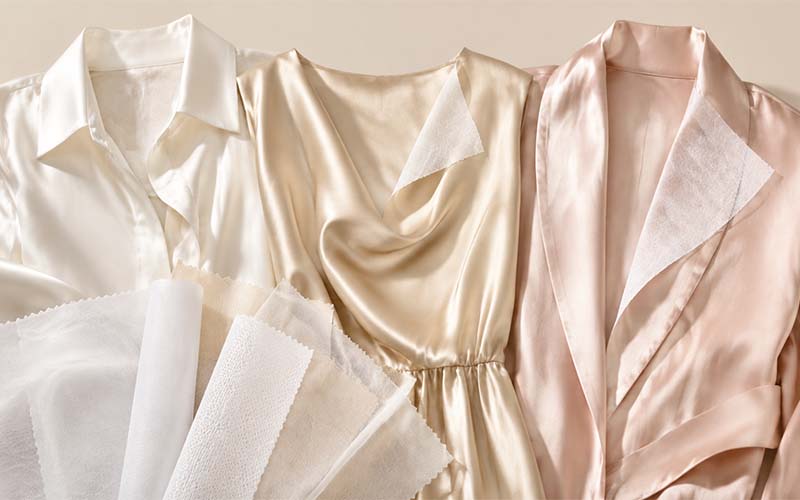
The best interfacing for silk is a lightweight material that provides enough support without changing the fabric’s natural drape, softness, color, or surface appearance.
For many silk shirts, dresses, and robes, a lightweight woven or knit fusible interfacing works well. However, silk organza or another sew-in interfacing may be safer for sheer, fluid, textured, or heat-sensitive silk.
There is no universal option for every garment. The final choice should be based on the silk construction, garment component, required structure, care method, and production process.
Table of Contents
What Is Interfacing for Silk?
Interfacing is an additional material used inside selected garment areas to improve shape, stability, and durability. It is commonly applied to:
- Collars and collar stands
- Cuffs and shirt plackets
- Neckline and armhole facings
- Waistbands
- Buttonholes and button areas
- Zipper openings
- Pocket openings
- Robe collars and belts
Interlining is a broader term for a layer placed between the outer fabric and the garment interior. In apparel manufacturing, “interlining” and “interfacing” are sometimes used interchangeably.
Regardless of terminology, the purpose is the same: to support the silk without making it look or feel unnaturally stiff.
Ask for Quote Now
Which Interfacing Is Best for Silk?
Suitable options include:
Lightweight woven fusible interfacing
Provides controlled structure for shirt collars, cuffs, plackets, facings, and waistbands.Soft knit or tricot fusible interfacing
Offers flexible support for soft silk, stretch silk, and areas that need to retain movement.Fine nonwoven fusible interfacing
Can be economical and easy to apply, but must be tested carefully because some products create a papery hand or visible edges.Silk organza sew-in interfacing
A lightweight and stable option for sheer silk, luxury garments, structured bodices, collars, and facings.Self-fabric reinforcement
Useful when maintaining consistent color, transparency, and hand feel is especially important.Narrow fusible or stay tape
Suitable for localized stabilization around necklines, shoulders, pocket openings, and zippers.
A practical rule is to choose the lightest interfacing that achieves the required stability.

Fusible vs. Sew-In Interfacing for Silk
Feature | Fusible interfacing | Sew-in interfacing |
Application | Bonded using heat, pressure, and time | Attached by stitching or enclosed in construction |
Production speed | Faster for bulk manufacturing | More labor-intensive |
Shape control | Consistent when correctly fused | Depends on material and sewing method |
Drape | May become stiff if too heavy | Often preserves a softer drape |
Main risk | Glue marks, shine, bubbling, or delamination | Added sewing time and possible internal movement |
Best for | Collars, cuffs, plackets, and facings | Sheer, delicate, heat-sensitive, or luxury silk |
Choose fusible interfacing when:
- The silk can tolerate the required fusing conditions.
- The adhesive does not show through the fabric.
- The garment requires consistent shape retention.
- Testing confirms sufficient bond strength.
- Fusing does not affect color, texture, or drape.
Choose sew-in interfacing when:
- The silk is sheer or highly heat-sensitive.
- Adhesive dots are visible from the face.
- The fabric develops shine or pressure marks.
- A soft, fluid or couture-quality finish is required.
- Fusible interfacing makes the garment too stiff.
Interfacing Recommendations by Silk Type
Different silk fabrics require different levels of support.
Silk charmeuse
Silk charmeuse is smooth, fluid, and likely to reveal adhesive, seam allowances, and interfacing edges. Use an exceptionally soft, lightweight fusible or a fine sew-in material such as silk organza.
Silk chiffon and georgette
These fabrics are sheer and delicate. Sew-in organza, self-fabric, stay tape, or localized reinforcement is often preferable to full-area fusing.
The reflective surface may show heat damage, shine, glue marks, or pressure impressions. Test samples under different lighting before approval.
Silk crepe de Chine
A lightweight woven or knit interfacing may be suitable, provided it does not flatten the texture or reduce fluidity.
Silk dupioni and silk twill
Silk dupioni and silk twill have a more structured and may accept lightweight woven fusible interfacing more easily. Avoid creating visible ridges beneath the textured surface.
Stretch silk
Choose a soft knit interfacing with compatible stretch and recovery. A rigid woven option may restrict movement or cause distortion.
Best Interfacing for Silk Shirts
Silk shirt interfacing should support the collar, cuffs, placket, and buttonholes without making the shirt feel like a heavy cotton garment.
A lightweight woven fusible is often suitable for a classic point collar or collar stand. A soft camp collar may need only minimal support, while an oversized or structured collar may require additional reinforcement.
Cuffs and plackets should be stable enough to support buttons and buttonholes. Possible methods include:
- Full lightweight interfacing inside the cuff
- Partial interfacing for a softer edge
- Local reinforcement around buttonholes
- Narrow fusible tape along folding lines
- Self-fabric reinforcement
Always test the buttonhole on the complete silk-and-interfacing combination. Use the same needle, thread, stitch density, and machinery planned for production.
Best Interfacing for Silk Dresses
Silk dresses usually need localized rather than full-area reinforcement. Common application areas include necklines, armholes, straps, bodices, waistbands, zippers, and closures.
For a fluid silk dress, narrow stay tape or lightweight facing support may prevent the neckline from stretching without affecting the overall drape.
A structured silk bodice may combine:
- Lightweight interfacing on the fashion fabric
- Silk organza underlining
- Local reinforcement at closures
- A separate internal foundation
Bias-cut silk dresses should not normally be fully interfaced because extensive support can restrict bias stretch and movement. Stabilize only essential areas such as necklines, straps, zippers, and closures.
Best Interfacing for Silk Robes
Silk robes should remain soft and comfortable, so heavy interlining is rarely appropriate.
Areas that may need support include:
- Shawl collars
- Front facings
- Cuffs
- Pocket openings
- Belt attachment points
- Belt ends and internal ties
For a silk robe collar, select a soft interfacing that maintains the roll line without causing the collar to stand away from the body. Partial reinforcement can also prevent a robe belt from becoming stiff or developing permanent creases.

How to Test Fusible Interfacing on Silk
Never approve interfacing based only on a supplier’s product description. Test the actual production silk and interlining together.
Step 1: Prepare samples
Use material from the intended production lot. Keep one unfused piece as a control sample.
Step 2: Follow recommended fusing conditions
Start with the interlining supplier’s specified temperature, pressure, and time. Do not automatically increase heat to improve bonding.
Step 3: Allow proper cooling
Avoid moving, stretching, or folding the fused sample before the adhesive has cooled and stabilized.
Step 4: Inspect the surface
Check the sample under multiple light sources for:
- Adhesive strike-through
- Shine or glazing
- Color change
- Bubbling
- Puckering
- Flattened texture
- Visible edges
Step 5: Compare hand feel and drape
Hang, bend, and fold the fused and unfused samples. The supported fabric should meet the design requirement without feeling excessively heavy or rigid.
Step 6: Test garment care
Wash, dry, steam, or dry-clean the sample according to the garment’s care instructions. Check for shrinkage, bubbling, peeling, and distortion.
Step 7: Make a complete component
Produce an actual collar, cuff, facing, or waistband. Some problems become visible only after sewing, turning, topstitching, and pressing.
Silk Interfacing Approval Checklist
Before bulk production, confirm that:
- The silk tolerates the required heat and pressure.
- Adhesive is not visible from the garment face.
- Color, texture, and luster remain unchanged.
- The reinforced area retains the intended drape.
- Interfacing edges do not create visible ridges.
- Collars, cuffs, and facings maintain their shape.
- Buttonholes and zipper openings do not distort.
- The bond remains stable after washing or dry cleaning.
- Grain or stretch direction is clearly specified.
- Approved fusing settings are recorded in the tech pack.
Common Problems and Solutions
Why does fusible interfacing bubble?
Bubbling can result from insufficient heat, pressure, or fusing time; premature handling; contamination; incompatible materials; or different shrinkage rates. Care testing is essential because bubbling may appear only after washing or dry cleaning.
Why does interfacing show through silk?
The product may be too thick, dark, textured, or heavily coated with adhesive. Select a finer material, use a closer color, reduce the fused area, soften the interfacing edge, or switch to a sew-in option.
How can glue marks on silk be prevented?
Use an interfacing with a fine adhesive coating and follow validated fusing settings. If adhesive strike-through continues, silk organza or another sew-in material may be safer.
Why does silk become stiff after fusing?
The interfacing may be too heavy, the adhesive coating may be too dense, or too much of the garment may have been fused. Try a softer product, partial application, narrow tape, or sew-in reinforcement.
FAQ
Can fusible interfacing be used on silk?
Yes. It can be used if testing confirms that it does not cause shine, color change, glue penetration, stiffness, shrinkage, or delamination.
Is silk organza suitable as interfacing?
Yes. Silk organza provides lightweight, stable support and is particularly useful for sheer silk, bodices, facings, and luxury garment construction.
Should interfacing be lighter than the silk?
In most cases, yes. However, the correct weight depends on the garment component and the required level of structure.
Does every silk garment need interfacing?
No. Interfacing should only be applied where stability, shape retention, or reinforcement is necessary.
Final Recommendation
The best interfacing for silk garments balances stability with softness. Lightweight woven or knit fusibles work well for many shirts, dresses, and robes, while silk organza and other sew-in options are often more suitable for sheer or heat-sensitive fabrics.
Always test the complete combination of silk, interfacing, fusing process, sewing construction, and care method before bulk production. Silkua provides professional silk garment solutions tailored to different design and manufacturing requirements. For product details, customization, or technical support, please Contact Us.
Request An Instant Quote For Your Brand!
You May Also Find These Topics Interesting
Silk Sleep Mask Filling Types: Which Material Offers The Best Comfort For YOU?
Silk Sleep Mask Filling Types:

How to Iron a Silk Dress Properly Without Damaging the Fabric
How to Iron a Silk Dress Prope

Top 10 Silk Home Textile Manufacturers In China
Top 10 Silk Home Textile Manuf