
How to Choose the Right Closure for Silk Pillowcases, Pajamas, and Robes

The right closure can determine whether your silk product feels comfortable, looks premium, and performs reliably after repeated use. An envelope closure may provide a smooth sleeping surface, while a concealed zipper can keep a pillow securely in place. For pajamas and robes, buttons, snaps, elastic waistbands, drawstrings, and inner ties each serve different customers and use cases.
This guide explains how you can compare closure types for silk pillowcases, pajamas, and robes. You will learn how fabric weight, product dimensions, care requirements, production costs, and customer preferences affect your decision. You will also find a practical comparison, development steps, a pre-production checklist, and frequently asked questions to help you create custom silk products with fewer sampling errors.
What Is the Best Closure for a Silk Product?
The best closure is one that fits the product’s function, fabric weight, intended customer, and retail positioning. There is no single option that works for every silk product.
For silk pillowcases, envelope and concealed zipper closures are usually the most practical. Pajama shirts commonly use lightweight buttons or snaps, while pajama bottoms perform well with soft elastic and an adjustable drawstring.
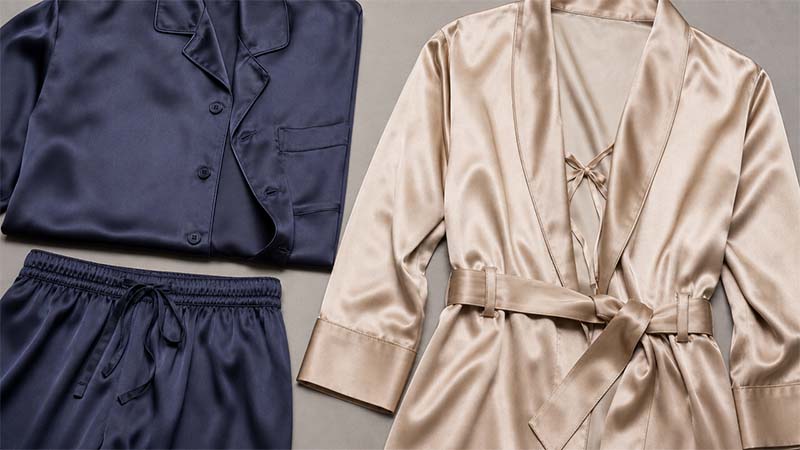
A traditional silk robe normally needs an outer belt and a discreet inner tie. Buttons, snaps, or concealed zippers may be added when you need more coverage or a structured silhouette.
Your closure should never be selected in isolation. You also need to consider the best stitching and seam choices for silk, the fabric’s drape, its thickness, and the stress placed on each fastening point.
Which Closure Is Best for a Silk Pillowcase?
Choose an envelope closure for a soft, hardware-free surface. Choose a concealed zipper when you need a snugger, more secure fit.
An envelope closure uses an overlapping silk panel to hold the pillow insert inside. It creates a clean appearance without adding metal or plastic components that may come into contact with the customer.
A zipper closure keeps the pillow from sliding out and can create a more tailored appearance. However, the zipper should be lightweight, smooth, color-matched, and concealed beneath a fabric edge.
An open-ended pillowcase is economical and easy to use, but it provides less security. It may be suitable for hospitality buyers who prioritize efficient laundering, although the final choice should reflect the hotel’s replacement and housekeeping requirements.
How Do Envelope And Zipper Closures Compare?
Feature | Envelope Closure | Concealed Zipper | Open End |
Sleeping comfort | Excellent | Very good if properly concealed | Excellent |
Pillow security | Good | Excellent | Limited |
Appearance | Soft and minimalist | Tailored and streamlined | Simple |
Hardware required | No | Yes | No |
Production complexity | Moderate | Higher | Low |
Risk of pillow exposure | Low with a deep flap | Very low | Higher |
Best for | Beauty and luxury collections | Premium fitted pillowcases | Hotels and basic collections |
The envelope flap must be deep enough to stay closed without creating excessive bulk. Its dimensions should be adjusted for the pillow size rather than applied as one standard measurement.
Before approving the design, review silk pillowcase sizes for Standard, Queen, King, and custom dimensions by region. A closure developed for one pillow size may not perform consistently when scaled to another.

Does Silk Momme Weight Affect the Pillowcase Closure?
Yes. Silk weight affects how the closure drapes, holds its shape, and supports added hardware.
A lightweight silk can be pulled out of shape by a bulky zipper or heavy trim. A heavier material provides more structure but may create thick layers when used in a deep envelope closure.
When evaluating 19 Momme vs 22 Momme silk pillowcases, you should test the complete construction rather than selecting a closure from the momme number alone. Weave, finish, seam allowance, and zipper tape can all change the result.
Your manufacturer should also account for shrinkage and dimensional stability. Hidden costs in silk pillowcase manufacturing can arise when zipper tape and silk react differently after washing, causing puckering, twisting, or uneven edges.
Ask for Quote Now
Which Closures Work Best for Silk Pajamas?
Lightweight buttons work well for classic silk pajama tops, while soft elastic combined with a drawstring is a versatile choice for pajama bottoms.
Mother-of-pearl buttons can create an elegant finish, but natural variations may affect color consistency. Polyester buttons provide easier color matching and cost control for larger orders.
Fabric-covered buttons offer a coordinated look, although they require additional labor and careful cleaning. Snaps are useful for adaptive, nursing, and maternity sleepwear because they can be easier to operate.
When developing silk pajama buttons, piping, and elastic, evaluate them as one design system. Large buttons, thick piping, and firm elastic can overpower lightweight silk and reduce comfort.
Should Pajama Bottoms Use Elastic Or A Drawstring?
Use elastic for convenience, a drawstring for adjustability, or combine both to provide a secure and flexible fit.
An elastic-only waistband is easy to wear and supports flexible sizing. However, the elastic must have suitable softness, width, and recovery to prevent pressure around the waist.
A drawstring-only waist allows adjustment but may loosen during sleep. If the customer must tie it tightly to keep the pants secure, the waistband may become uncomfortable.
For many custom sleepwear collections, soft elastic with an adjustable drawstring offers the best balance. You should also test whether the elastic twists inside the casing and whether the drawstring ends fray after laundering.
Are Snaps Suitable for Silk Pajamas?
Snaps are suitable when accessibility and fast opening are more important than a traditional button-front design.
Lightweight hidden snaps can be placed behind a front placket to maintain a clean appearance. Decorative buttons may then be added on top without serving as the functional closure.
Every snap area should be reinforced because repeated pulling concentrates stress on a small section of fabric. Pull-strength testing is essential before bulk production.
Avoid snaps that are difficult to separate. If excessive force is required, your customer may pull the silk instead of holding the snap, increasing the risk of tearing.
What Is the Most Secure Closure for a Silk Robe?
An inner tie combined with an outer belt is usually the most practical closure for a wrap-style silk robe.
The inner tie keeps the overlapping panels aligned, while the belt adjusts the robe around the waist. This combination provides more coverage than an outer belt alone.
A removable belt offers styling flexibility but can be lost during washing or storage. An attached belt remains with the garment, although the attachment points must be reinforced to withstand repeated pulling.
Private label silk robes require careful size grading, belt placement, and shrinkage control. Belt loops should not remain in the same position across every size if doing so prevents the robe from sitting naturally at the waist.
Can You Use Buttons, Snaps, Or Zippers on Silk Robes?
Buttons work well when you want a robe to resemble a structured lounge dress. The button and buttonhole areas should be stabilized so that repeated fastening does not distort the silk.
Hidden snaps can provide additional coverage without changing the appearance of a traditional wrap robe. They should be positioned after a fit test because poor placement may cause pulling across the chest or hips.
A concealed zipper is less common but can suit fitted loungewear or front-opening garments. It should follow the garment’s drape without making the front stiff or wavy.
For bridal, spa, and relaxed luxury robes, an inner tie and belt usually provide the most natural result. For active movement or secure coverage, you can consider a secondary snap or button.
How Can You Select a Closure Step by Step?
Follow these steps before preparing your final sample:
Define the product’s use. Decide whether you are producing sleepwear, bedding, bridal apparel, hotel products, or daily loungewear.
Identify your customer’s priority. Determine whether your customer values softness, security, accessibility, fast laundering, adjustability, or decorative appeal.
Confirm the silk specification. Review the silk type, momme weight, finish, drape, shrinkage, and color before selecting hardware.
Choose the closure structure. Compare envelope panels, zippers, buttons, snaps, elastic, drawstrings, and ties according to the intended use.
Develop the correct dimensions. Define flap depth, zipper length, button spacing, waistband width, drawstring length, and belt-loop placement.
Add reinforcement where needed. Stabilize zipper ends, snap positions, buttonholes, inner ties, and belt loops without making the silk unnecessarily stiff.
Test a complete sample. Conduct fit, sleep, washing, closure-cycle, and appearance tests before confirming bulk production.
You should record these specifications when you prepare a tech pack for silk garment manufacturing. Clear measurements and construction diagrams reduce misunderstandings between your design team and factory.
What Should Your Pre-Production Checklist Include?
Use this checklist before approving your closure:
- Does the closure suit the product’s intended use?
- Is the hardware lightweight enough for the selected silk?
- Can your customer open and close it comfortably?
- Does it create pulling, puckering, sagging, or bulk?
- Are all high-stress areas properly reinforced?
- Is the zipper tape or button color consistent with the fabric?
- Does the closure remain stable after washing or dry cleaning?
- Are there any rough edges against the skin?
- Are envelope flaps, ties, belts, and drawstrings long enough?
- Does the closure work across every product size?
- Has the sample passed repeated opening and closing tests?
- Are replacement trims available for future production?
This process can become part of your essential quality control checklist for silk pajamas, robes, and lingerie. It can also help prevent common quality issues in silk pillowcases before they reach your customers.
How Does the Closure Affect MOQ And Production Cost?
Closures affect material costs, sewing time, sampling requirements, inspection procedures, and minimum order quantities.
An open-end pillowcase normally requires fewer production steps than a concealed zipper design. Fabric-covered buttons and custom logo hardware require more development than standard stock components.
Custom zipper colors, engraved buttons, and branded snaps may have separate supplier MOQs. Even if your garment factory accepts a small order, the trim supplier may require you to purchase more components than the current production run needs.
A complete silk products MOQ and price breakdown should therefore separate fabric, trims, labor, packaging, testing, and expected wastage. Choosing the lowest-cost closure is not always economical if it increases defect rates or customer returns.
What Are the Most Common Closure Quality Problems?
Common problems include wavy zippers, loose snaps, cracked buttons, stretched buttonholes, twisting elastic, frayed drawstrings, and poorly positioned robe loops.
A closure may also be technically functional but uncomfortable in real use. For example, a zipper puller may touch the face, or an inner robe tie may create a visible lump beneath fine silk.
Color inconsistency is another risk. Zipper tape, elastic, thread, and buttons may absorb dye differently from silk, even when suppliers use the same color reference.
You can reduce defect rates by approving physical trim samples, testing the finished product, and defining acceptable tolerances before production begins.
Frequently Asked Questions
Is A Zipper Or Envelope Closure Better for a Silk Pillowcase?
An envelope closure is better if you want a completely hardware-free sleeping surface. A concealed zipper is better if keeping the pillow securely enclosed is your main priority.
Can A Zipper Damage Silk?
A heavy, rough, or poorly installed zipper can distort or snag delicate silk. You should use a lightweight zipper with smooth teeth, stable tape, and protected ends.
What Is the Best Waistband for Silk Pajamas?
Soft elastic combined with an adjustable drawstring is suitable for many collections. It provides convenience, security, and flexible sizing without requiring the customer to rely on one closure method.
Why Does A Silk Robe Need an Inner Tie?
An inner tie holds the robe’s front panels in position before the outer belt is secured. It improves coverage and helps prevent smooth silk from slipping open.
Should You Test Closures After Washing?
Yes. Washing tests can reveal shrinkage, color transfer, rust, deformation, elastic failure, and differences in dimensional stability between the closure and silk.
How Can You Avoid Closure Problems in Bulk Production?
Provide a detailed tech pack, approve physical trims, test a finished sample, establish tolerances, and use a consistent quality control process. You should not approve a closure based only on photographs.
How Can Silkua Help You Develop the Right Closure?
Choosing the right closure requires more than selecting a button, zipper, or tie from a catalog. You need to balance comfort, appearance, fabric performance, target cost, manufacturing efficiency, and customer expectations.
Silkua can help you develop custom silk pillowcases, pajamas, robes, and accessories with suitable closures, stitching, reinforcement, and branded trims. You can compare materials, review samples, refine your tech pack, and prepare the design for scalable production.
Contact Us today and complete the inquiry form to request a customized quotation from Silkua. By confirming your closure details early, you can reduce sampling revisions, control production costs, prevent avoidable defects, and bring a more reliable silk collection to market faster.