

Reducing defect rates in silk pillowcases, eye masks, and scrunchies starts long before final inspection. It begins with choosing stable silk fabric, confirming samples, setting clear quality standards, and controlling every production step from cutting to packaging.
If you are building a private label silk product line, poor quality can lead to returns, negative reviews, and damage to your brand image. In this guide, you will learn how to prevent common defects in silk accessories, what to check during production, and how to work with a manufacturer that understands silk pillowcase quality control, silk eye mask quality control, and silk scrunchie inspection.
Table of Contents
Why Defect Control Matters For Custom Silk Accessories
When customers buy silk pillowcases, eye masks, or scrunchies, they expect a smooth touch, elegant appearance, accurate color, and reliable durability. These products are often used for beauty sleep, hair care, gifting, and premium lifestyle collections, so small defects are easy to notice.
A loose thread, uneven seam, color difference, weak elastic, or damaged gift box may seem minor during production. But for your customer, it can lower the perceived value of your entire brand.
Strong quality control for silk accessories helps you reduce returns, improve customer satisfaction, and build a more consistent product line. It also makes your products easier to sell across e-commerce, retail, spa, hotel, and beauty channels.
What Are The Most Common Defects In Silk Products?
Before you can reduce defects, you need to know where they usually appear. Silk is delicate, smooth, and naturally glossy, which means production mistakes can be more visible than on many other fabrics.
Common defects in silk pillowcases include stains, weaving marks, color differences, seam puckering, size errors, crooked labels, and poor closure finishing. These issues are especially noticeable because pillowcases have large flat fabric panels.
Common quality issues in silk eye masks include uneven padding, poor nose curve, weak elastic straps, asymmetrical shape, loose stitching, and light leakage around the face.
Common defects in silk scrunchies include weak elastic, loose seams, uneven fullness, poor fabric gathering, and size inconsistency. These issues can affect both appearance and daily use.
Ask for Quote Now
Subscribe to Product Updates
Silk care tips and new arrivals — straight to your inbox.
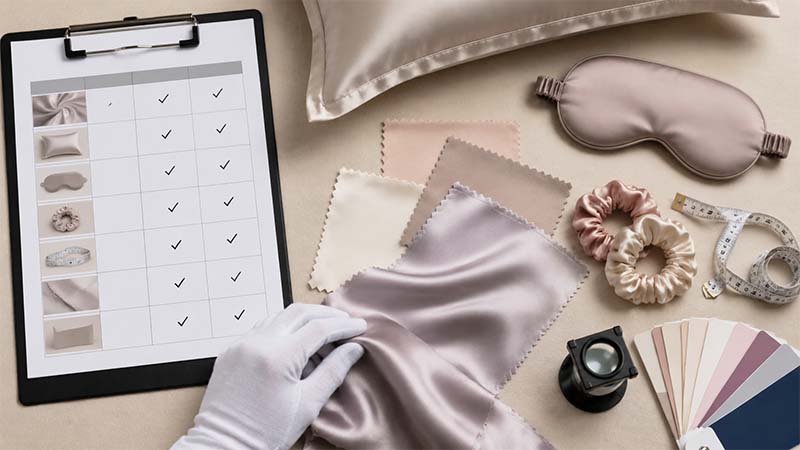
Use A Silk Product Quality Control Checklist
A clear silk product quality control checklist helps your team and your supplier inspect products in the same way. It reduces misunderstandings and makes quality expectations easier to measure.
A practical checklist should include:
- Silk fabric surface inspection
- Color consistency check
- Fabric weight and hand feel confirmation
- Size and shape measurement
- Cutting accuracy inspection
- Stitching and seam quality check
- Elastic recovery test
- Padding and filling inspection for eye masks
- Label and logo position check
- Packaging and gift box inspection
- Final product inspection before shipment
This type of checklist is useful for custom silk pillowcases, silk sleep masks, scrunchies, and complete silk sleep sets.
Step 1: Start With Stable Mulberry Silk Fabric
Many silk product defects come from the fabric itself. If the raw material has stains, weaving defects, unstable dyeing, or inconsistent thickness, these problems may appear in the finished product.
You should confirm the silk type, momme weight, weave, color, shrinkage rate, and surface quality before bulk production. For custom silk pillowcases, 19 momme and 22 momme mulberry silk are common choices, depending on your market positioning and target price.
For silk eye masks, the fabric should feel soft against the skin and work well with padding. For silk scrunchies, the fabric should be gentle on hair but strong enough for repeated use.
Request fabric swatches before production. If color is important, ask for lab dips or printed strike-offs so you can review the look before approving bulk fabric.
Step 2: Inspect Silk Fabric Before Cutting
Fabric inspection is one of the easiest ways to prevent visible defects. Once defective fabric is cut and sewn, it becomes much harder and more expensive to fix.
During inspection, your manufacturer should check for oil marks, stains, holes, slubs, dyeing streaks, color shading, creases, and weaving irregularities. Defective areas should be marked and avoided during cutting.
For silk pillowcases, fabric inspection is especially important because large panels show imperfections clearly. For silk eye masks, defects on the front surface can affect the premium look. For silk scrunchies, weak or uneven fabric may affect the final volume and durability.
A reliable silk accessories manufacturer should inspect the fabric under proper lighting and keep defective fabric away from production.
Step 3: Control Color Consistency In Dyeing And Printing
Color difference is one of the most common concerns in custom silk products. It can happen between sample and bulk production, between fabric batches, or between different items in the same gift set.
If you are creating a silk pillowcase, eye mask, and scrunchie gift set, all pieces should look coordinated. Even a small shade difference may be noticeable when the products are packed together.
To reduce this risk, approve lab dips before dyeing and strike-off samples before printing. Check the color under natural light and indoor light, because silk’s shine can make the same color appear slightly different.
If you use brand colors, provide Pantone references. At the same time, allow a reasonable tolerance because silk reflects light differently from paper or synthetic fabrics.
Step 4: Confirm Measurements And Tolerances
Size accuracy is important for both function and appearance. A pillowcase that does not fit the pillow correctly may look unprofessional. An eye mask with the wrong strap length may feel too tight or too loose. A scrunchie with weak stretch may not hold hair properly.
For pillowcases, confirm the finished size, closure type, seam allowance, flap depth, zipper position, and acceptable size tolerance. For eye masks, confirm width, height, strap length, elastic tension, nose curve, and padding thickness.
For scrunchies, confirm the outer diameter, fabric width, elastic length, stretch range, and finished fullness. These small details have a direct effect on customer experience.
Before bulk production, approve a pre-production sample. This sample should become the standard reference for the entire order.
Step 5: Improve Cutting Accuracy
Silk fabric is smooth and slippery, so cutting accuracy requires experience. If the fabric shifts during cutting, the final product may have uneven edges, twisted seams, or an unbalanced shape.
For custom silk pillowcases, inaccurate cutting may cause poor alignment and uneven corners. For silk eye masks, inaccurate cutting can make the two sides look asymmetrical. For silk scrunchies, uneven strips can affect the final shape and gathering.
Your supplier should use accurate patterns, stable fabric layers, suitable cutting tools, and trained workers. If the product includes custom printing or logo placement, cutting must also follow the print direction and pattern position.
Good cutting control reduces sewing problems later in production.
Step 6: Set Clear Sewing Quality Standards
Sewing is where many visible defects appear. Common sewing issues include skipped stitches, loose threads, crooked seams, needle marks, seam puckering, and uneven stitch length.
Silk requires careful machine settings. The needle should be fine enough for the fabric, the thread should match the material, and the machine tension should not be too tight. If the sewing tension is wrong, puckering may appear along the seams.
For pillowcases, the edges should be straight and smooth. For eye masks, curves should be clean and symmetrical. For scrunchies, the closing seam should be secure and comfortable.
You should define sewing standards before production, including stitch density, seam tolerance, thread color, trimming requirements, and acceptable defect levels.
Step 7: Test Elastic Quality For Eye Masks And Scrunchies
Elastic quality is critical for silk eye masks and scrunchies. Even if the silk fabric looks beautiful, weak elastic can make the product feel low quality.
For eye masks, the strap should hold the mask in place without pressing too tightly on the head. It should recover well after stretching and remain comfortable during sleep.
For scrunchies, the elastic should hold hair securely without pulling, breaking, or losing shape too quickly. Poor elastic recovery is one of the main reasons silk scrunchies lose elasticity after use.
Before mass production, test the elastic stretch range, recovery rate, softness, and durability. This helps prevent customer complaints after the product reaches the market.
Step 8: Check Padding And Fit In Silk Eye Masks
Silk eye mask quality control should include both appearance and wearing comfort. A good eye mask should feel soft, sit comfortably on the face, and block light effectively.
Uneven padding can create lumps, wrinkles, or an unbalanced shape. A poorly designed nose curve may allow light to enter, reducing the product’s value for sleep use.
You should confirm the filling material, padding thickness, softness, and distribution. Also check whether the mask shape is symmetrical and whether the elastic strap fits your target customer group.
For premium gift sets, comfort testing is just as important as visual inspection.
Product Comparison: Main Defect Risks By Category
The table below summarizes the main defect risks and quality control focus for each silk accessory.
Product | Common Defect Risks | Key Quality Control Focus |
Silk Pillowcase | Color difference, stains, puckering, size errors, poor closure | Fabric inspection, measurement, stitching, closure finishing |
Silk Eye Mask | Uneven padding, weak elastic, asymmetrical shape, light leakage | Padding, strap tension, shape, nose curve, comfort testing |
Silk Scrunchie | Weak elastic, loose seam, uneven fullness, size inconsistency | Elastic recovery, seam strength, fabric gathering, final shape |
Silk Gift Set | Color mismatch, damaged box, incorrect logo, poor presentation | Set matching, logo position, packaging inspection, final display |
This comparison helps you identify where to focus your inspection based on the product type you are ordering.

Step 9: Inspect Labels, Logos, And Packaging
For private label silk products, branding details matter. A crooked label, unclear logo, wrong color, or damaged gift box can reduce the premium feeling of the product.
You should confirm the logo size, label position, care label content, printing method, packaging structure, insert card, barcode, and carton marks before production.
If you are developing custom silk gift set packaging, make sure the box fits the products properly and protects them during shipping. The packaging should look refined but also be strong enough for storage and delivery.
Final packaging inspection should check cleanliness, color, printing accuracy, box shape, product placement, and overall presentation.
Step 10: Use In-Line And Final Inspection
Quality inspection should not happen only after production is finished. In-line inspection helps identify problems while there is still time to correct them.
During in-line inspection, your manufacturer should check semi-finished products, sewing quality, measurements, elastic quality, padding, and labels. If defects appear, the team can adjust machine settings or improve handling before the whole batch is completed.
Final product inspection should compare finished goods with the approved sample. It should include appearance, size, color, stitching, function, packaging, quantity, and carton labeling.
This process helps you control quality before shipment and avoid costly after-sales problems.
How To Choose A Reliable Silk Accessories Manufacturer
Choosing the right supplier is one of the most important steps in reducing defect rates. A reliable manufacturer should understand silk fabric behavior, custom product development, private label requirements, and export quality expectations.
You should ask about their fabric inspection process, sampling workflow, dyeing and printing control, sewing standards, in-line inspection, final inspection, and packaging options.
A professional custom silk accessories manufacturer should also tell you about possible risks before production begins. This is especially important for custom colors, printed designs, special packaging, and complete silk sleep sets.
When your supplier has a strong QC system, you can save time, reduce returns, and create a more stable product line.
FAQ: Reducing Defects In Silk Pillowcases, Eye Masks, And Scrunchies
What Are The Most Common Defects In Silk Pillowcases?
How Can You Reduce Defect Rates In Custom Silk Products?
You can reduce defect rates by confirming fabric quality, approving lab dips and samples, setting clear measurement tolerances, controlling cutting and sewing, testing elastic quality, inspecting packaging, and conducting in-line and final inspections.
Why Do Silk Eye Masks Have Uneven Padding?
Uneven padding often happens when the filling material is not distributed evenly or the sewing process does not control the shape properly. To prevent this, you should confirm padding thickness, filling type, mask shape, and comfort before bulk production.
Why Do Silk Scrunchies Lose Elasticity?
Silk scrunchies usually lose elasticity because of low-quality elastic, incorrect elastic length, weak recovery, or poor construction. Testing stretch and recovery before mass production helps reduce this issue.
Why Is A Pre-Production Sample Important?
A pre-production sample gives you a physical standard for fabric, size, color, sewing, logo, packaging, and overall quality. It helps your manufacturer keep bulk production consistent with your approved requirements.
How Silkua Helps You Improve Silk Product Quality
Silkua helps brands develop custom silk pillowcases, silk eye masks, silk scrunchies, silk sleep sets, and custom silk gift set packaging with a focus on quality control from start to finish.
Our production process includes fabric inspection, sample confirmation, color review, cutting control, sewing inspection, elastic testing, packaging checks, and final product inspection. This helps you reduce defect risks before products reach your customers.
Whether you are building a beauty brand, lifestyle collection, hotel gift set, spa product line, or private label silk collection, Silkua can support your customization needs with practical manufacturing experience.
Ready To Reduce Defects In Your Silk Product Line?
If you want to create better silk pillowcases, eye masks, scrunchies, or complete silk sleep sets, quality control should start before bulk production.
Contact Us today to discuss your custom project with Silkua. Share your product type, quantity, fabric preference, logo design, and packaging ideas. Our team can help you review the details, reduce production risks, and provide a custom quotation for your brand.
Start now and build silk products your customers will trust, love, and reorder.
Request An Instant Quote For Your Brand!
You May Also Find These Topics Interesting
Are Silk Pillowcases Good for Your Skin? The Ultimate Guide
Are Silk Pillowcases Good for
How to Choose Luxury Silk Packaging Without Overpaying
How to Choose Luxury Silk Pack
Pillowcase Material Selection: The Ultimate FAQ Guide for Brand Buyers
Pillowcase Material Selection: