
Single-Sided vs Double-Sided Silk Scarf Printing
Choosing between single-sided and double-sided printing is one of the most important decisions when producing custom silk scarves. It affects how the reverse side looks, whether text remains readable, how the scarf feels, and how much production costs.
Quick Answer
Single-sided silk scarf printing is the most practical choice when a lighter, mirrored reverse is acceptable. It generally offers a softer hand feel, simpler production, and a lower cost.
Double-sided silk scarf printing is more suitable when both sides require controlled colors, readable text, or separate designs. It provides greater design flexibility but usually involves more complex production and a higher price.
The right method depends on the scarf’s intended use, artwork, silk fabric, momme weight, quantity, and target price.

What Is Single-Sided Silk Scarf Printing?
Single-sided silk scarf printing means that the main design is applied from one side of the fabric. As the dye penetrates the silk fibers, part of the design becomes visible on the reverse.
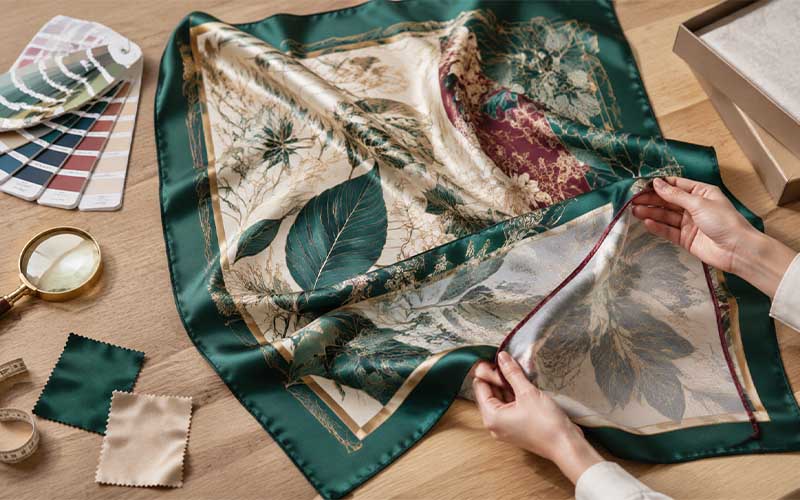
The back is therefore usually not blank. It generally shows a lighter, mirrored version of the front design.
The final front-to-back color difference depends on:
- Silk type and weave
- Fabric thickness and momme weight
- Printing method
- Dye penetration
- Artwork colors and coverage
- Steaming, washing, and finishing
- Production settings
Single-sided printing is commonly used for fashion scarves, branded accessories, corporate gifts, art merchandise, and promotional products.
Why Is the Reverse Side Lighter?
In single-sided printing, the color is applied primarily from one surface. The dye must travel through the silk fibers before it becomes visible on the reverse, so the back usually has lower saturation.
Lightweight or more open silk constructions may allow stronger color penetration. Heavier or tightly woven silk can create a more noticeable difference between the two sides.
Dark backgrounds, bold borders, and large solid-color areas can also make the difference easier to see.
Ask for Quote Now
What Is Double-Sided Silk Scarf Printing?
Double-sided silk scarf printing is a production method designed to create a more intentional and controlled appearance on both sides of a scarf.
It can usually be divided into two constructions:
- Single-layer double-sided printing
- Two-layer reversible construction
These methods differ in thickness, artwork flexibility, production process, and price.
Single-Layer Double-Sided Printing
A single piece of silk is printed from both sides using controlled production and alignment. This method can improve reverse-side color and make both surfaces more visually consistent.
However, because silk is thin and absorbent, dyes applied from opposite sides may interact. The manufacturer must assess:
- Fabric thickness
- Color combinations
- Design coverage
- Border placement
- Registration requirements
- Front-to-back alignment
Single-layer double-sided printing can retain a relatively lightweight feel, but not every design or fabric is suitable for this method.
Two-Layer Reversible Silk Scarves
A two-layer reversible scarf is made from two separately printed pieces of silk. The layers are joined and finished to create one product.
This construction is suitable when:
- Each side needs a different design
- Text must be readable on both sides
- Front and back colors require independent control
- The scarf is intended to be fully reversible
- A heavier or more structured feel is acceptable
Two-layer construction offers greater design flexibility but uses more fabric and requires additional printing, alignment, sewing, finishing, and quality inspection.
Single-Sided vs Double-Sided Silk Scarf Printing
The following comparison summarizes the main differences.
Comparison factor | Single-sided printing | Double-sided printing |
Reverse appearance | Lighter and mirrored | More intentional and controlled |
Number of designs | One primary design | Same or different designs |
Text on the reverse | Usually mirrored | Can remain readable |
Color control | Focused on the front | Managed on both sides |
Fabric layers | Usually one | One or two |
Alignment requirements | Relatively low | Higher |
Production complexity | Lower | Higher |
Relative cost | More economical | Usually more expensive |
Best for | Standard fashion and promotional scarves | Premium and reversible scarves |
A physical sample is recommended because different manufacturers may use different processes under the term “double-sided printing.”
Which Printing Option Is Better?
Neither option is universally better. The best method is the one that meets the scarf’s functional, visual, and commercial requirements without introducing unnecessary production costs.
Choose Single-Sided Printing If:
- The front carries the main design
- A lighter mirrored reverse is acceptable
- The scarf should remain lightweight
- Cost control is important
- The artwork does not contain text that must be readable from both sides
- The order includes multiple designs or colorways
- The product is not marketed as reversible
Choose Double-Sided Printing If:
- Both surfaces are visible during normal use
- Text or logos must be readable from either side
- The scarf needs two different designs
- Front and back colors require greater control
- The product is intended to be reversible
- A premium construction supports the retail positioning
- The additional manufacturing cost is commercially justified
Double-sided printing should be selected for a clear design or functional reason, rather than simply because it sounds more premium.
How Much Does Custom Silk Scarf Printing Cost?
There is no universal custom silk scarf price per piece. The cost depends on the complete product specification.
The main pricing factors include:
- Silk type
- Momme weight
- Scarf dimensions
- Printing construction
- Number of fabric layers
- Artwork complexity
- Number of designs and colorways
- Order quantity
- Edge finishing
- Labels and packaging
- Sampling requirements
- Quality inspection and testing
For example, a large scarf made from heavier silk generally requires more material than a small, lightweight scarf. A hand-rolled hem also requires a different finishing process from a machine-stitched edge.
An accurate quotation should therefore be based on complete specifications rather than size or printing method alone.
Is Double-Sided Silk Scarf Printing More Expensive?
Yes, double-sided silk scarf printing usually costs more than standard single-sided printing. It may require additional printing, artwork preparation, color testing, alignment, labor, machine time, and inspection.
A two-layer reversible scarf also requires extra fabric, sewing, and finishing.
However, double-sided printing is not necessarily twice the price. Some costs, such as file checking, packaging, project management, and labels, may remain similar.
The price difference depends on:
- Single-layer or two-layer construction
- Same or different artwork on each side
- Fabric type and momme weight
- Scarf dimensions
- Color-matching requirements
- Border and motif alignment
- Quantity per design
- Edge-finishing method
- Sampling requirements
- Packaging specifications
To compare single-sided vs double-sided printing costs accurately, request quotations using the same silk, size, quantity, hem, label, packaging, and quality standard.

Which Silk Fabric Is Best for Printed Scarves?
The best silk fabric depends on the desired texture, shine, drape, opacity, print performance, and product positioning.
Silk Twill
Silk twill has a subtle diagonal weave and a soft yet structured feel. It is often used for premium square scarves because it supports detailed artwork and holds its shape well.
Suitable for: luxury fashion scarves, detailed patterns, branded collections, and structured square scarves.
Silk Satin or Charmeuse
Silk satin has a smooth, glossy surface and fluid drape. Printed colors can appear luminous, although the sheen may change their appearance under different lighting.
Suitable for: elegant scarves, vibrant artwork, smooth accessories, and designs requiring a glossy finish.
Silk Habotai
Silk habotai is lightweight, smooth, and soft. Its relatively light construction can allow noticeable color penetration.
Suitable for: lightweight scarves, promotional accessories, and single-sided designs where a mirrored reverse is acceptable.
Silk Chiffon
Silk chiffon is sheer, airy, and slightly textured. Its transparency creates a different visual effect from opaque silk fabrics.
Suitable for: lightweight fashion scarves, layering accessories, and soft, flowing designs.
Crepe de Chine
Crepe de chine has a subtle texture, low sheen, and soft drape. It provides a more understated surface than satin.
Suitable for: fashion scarves that require a refined, less glossy appearance.
No fabric should be selected by name alone. Sampling the chosen silk with the actual artwork provides a more reliable indication of color, drape, opacity, and reverse-side appearance.
How Does Momme Weight Affect Silk Scarf Printing?
Momme is a traditional measurement of silk fabric weight. It influences thickness, opacity, durability, drape, ink penetration, hand feel, and price.
Lighter Momme Silk
Lighter silk may:
- Feel more delicate and airy
- Allow greater color penetration
- Appear more transparent
- Provide a softer, flowing drape
- Require careful handling and finishing
Heavier Momme Silk
Heavier silk may:
- Feel more substantial
- Provide greater opacity
- Offer a more structured drape
- Reduce visible color penetration on the reverse
- Increase material costs
A higher momme weight is not automatically better. It must suit the scarf’s size, intended use, design, edge finish, and target market.
Artwork Requirements for Double-Sided Silk Scarves
Same Design on Both Sides
When the same design is required on both surfaces, the files may need to be mirrored or adjusted according to the production method.
Borders, central motifs, logos, and directional elements should be reviewed for front-to-back alignment.
Different Designs on Each Side
Two different designs are possible, but the artwork should use compatible dimensions and border structures.
Major differences in layout or visual weight may make alignment, cutting, and edge finishing more difficult.
Text and Logos
Text on the reverse of a single-sided scarf will normally appear mirrored. If text or a logo must be readable from both sides, a double-sided printing method should be considered.
Avoid placing essential text too close to the edge. Minor movement can occur during printing, cutting, sewing, and hand rolling.
Borders and Registration
Narrow, geometric, or highly symmetrical borders can make small alignment differences more visible. Softer borders and flexible edge details may be easier to produce consistently.
Before sampling, check:
- Final scarf dimensions
- Artwork resolution
- File format and color mode
- Bleed allowance
- Safe area
- Border width
- Text orientation
- Front and back placement
- Color references
- File names and version numbers
How to Choose the Right Silk Scarf Printing Method
Follow these steps before confirming production.
Step 1: Define the Intended Use
Decide how the scarf will be worn or presented. It may be used as:
- A neck scarf
- A headscarf
- A handbag accessory
- A pocket square
- A fashion wrap
- A corporate gift
- A piece of textile art
- A reversible accessory
If both sides will often be visible, reverse-side appearance should receive greater attention.
Step 2: Identify Essential Requirements
Determine whether the product needs:
- One or two designs
- Readable text on both sides
- Matching front and back colors
- Precisely aligned borders
- A lightweight construction
- A reversible function
- Premium retail positioning
Separate essential features from optional preferences to avoid unnecessary complexity and cost.
Step 3: Select the Silk and Momme Weight
Evaluate the fabric’s:
- Texture
- Shine
- Drape
- Thickness
- Opacity
- Print penetration
- Durability
- Suitability for the selected edge finish
Request fabric swatches when comparing unfamiliar silk types.
Step 4: Prepare Production-Ready Artwork
Submit the artwork at the correct final dimensions and follow the manufacturer’s technical requirements.
For double-sided designs, label the front and back files clearly. Include color references and identify any text, logos, borders, or motifs that require precise positioning.
Step 5: Order a Physical Sample
A digital mockup cannot accurately reproduce fabric texture, sheen, drape, color penetration, alignment, or hand feel.
A physical sample helps verify:
- Printed colors
- Reverse-side appearance
- Front-to-back alignment
- Fabric quality
- Scarf dimensions
- Edge finishing
- Labels
- Overall construction
Step 6: Compare Quotations Equally
Ensure that each supplier quotation is based on the same:
- Scarf dimensions
- Silk type
- Momme weight
- Printing construction
- Quantity per design
- Edge finish
- Label type
- Packaging method
- Sample requirements
- Quality standard
- Shipping terms
A lower quotation may not include the same materials, finishing, or services.
Step 7: Approve a Production Standard
Document the approved fabric, colors, dimensions, print placement, hem, labels, packaging, and tolerances.
Keep the approved sample as the reference for bulk production and final inspection.
Custom Silk Scarf Pre-Production Checklist
Product Specifications
- Final dimensions confirmed
- Silk type selected
- Momme weight confirmed
- Printing method selected
- Single-layer or two-layer construction confirmed
- Edge finish selected
- Label type and placement approved
- Packaging requirements documented
Artwork
- Production-resolution files supplied
- Front and back files clearly named
- Bleed and safe areas checked
- Text orientation confirmed
- Borders reviewed for alignment risk
- Color references supplied
- Final file version identified
Sampling and Production
- Sample price confirmed
- Sample lead time confirmed
- Bulk production time confirmed
- Custom silk scarf MOQ confirmed
- Quantity per design confirmed
- Physical sample approved
- Quality tolerances documented
- Inspection method confirmed
- Shipping and packaging confirmed
This checklist is particularly important for custom double-sided silk scarves because unclear specifications can lead to unexpected differences in color, alignment, thickness, hand feel, and price.
Common Silk Scarf Printing Mistakes
Assuming the Reverse Will Be Blank
The back of a single-sided printed silk scarf is generally not blank. It normally shows a lighter, mirrored version of the front design.
Treating All Double-Sided Printing as the Same
“Double-sided” may refer to single-layer printing from both surfaces or a two-layer reversible construction. Always confirm the actual manufacturing method.
Selecting Fabric Based Only on Appearance
Silk type and momme weight also affect print penetration, drape, opacity, durability, finishing, and cost.
Using Narrow Borders Without Confirming Tolerances
Silk can move slightly during printing and finishing. Narrow or perfectly symmetrical borders can make minor variations more noticeable.
Approving Color Only on a Screen
Screen colors do not fully represent how dyes will appear on silk. Fabric sheen, weave, lighting, and finishing can all affect the final result.
Comparing Incomplete Quotations
A quotation may exclude samples, custom labels, hand-rolled hems, packaging, testing, shipping, or inspection. Compare the complete product and service package.
Frequently Asked Questions
Is the back of a single-sided printed silk scarf blank?
No. The reverse usually displays a lighter, mirrored version of the front design because part of the dye penetrates the silk fibers.
Will text appear reversed on the back?
Yes. With conventional single-sided printing, text and directional logos normally appear mirrored on the reverse. Double-sided printing may be required if they must remain readable.
Can a silk scarf have different designs on each side?
Yes. Different artwork can be created using an appropriate single-layer double-sided method or a two-layer reversible construction. Feasibility depends on the fabric, design, alignment, and finishing.
Does double-sided printing make a scarf thicker?
Not always. A single-layer double-sided scarf may remain lightweight. A two-layer reversible silk scarf will generally feel thicker and more structured.
Is double-sided printing twice as expensive?
Not necessarily. It usually costs more, but the final difference depends on the fabric layers, artwork, size, quantity, alignment, finishing, and sampling requirements.
What is the MOQ for custom silk scarves?
The custom silk scarf MOQ varies by manufacturer, fabric, printing method, dimensions, and number of designs. Confirm whether the MOQ applies to the total order, each design, or each colorway.
Which silk is best for double-sided scarf printing?
There is no single best silk for every double-sided design. Silk twill, satin, habotai, and other fabrics produce different results. The final choice should be verified through physical sampling.
Can Pantone colors be matched on silk?
Pantone references can be used as color targets. However, fabric weave, sheen, dye absorption, lighting, and finishing may affect the final appearance. A physical color sample is recommended when color accuracy is important.
Should I order a sample before bulk production?
Yes. A physical sample is the most effective way to check fabric, color, dimensions, print penetration, alignment, labels, edge finishing, and overall quality.
What information is needed for a quotation?
Provide:
- Scarf dimensions
- Silk type
- Momme weight
- Single- or double-sided printing
- Single- or two-layer construction
- Artwork files
- Quantity per design
- Edge finish
- Label requirements
- Packaging specifications
- Delivery destination
- Testing or inspection requirements
Complete information helps manufacturers provide a more accurate custom silk scarf printing cost.